.webp)
Big Data has empowered organizations to inspect substantial volumes of structured and unstructured data. Big Data augments decision-making by delivering data and conclusions from the projected valuable information. Organizations are presently in a situation to consolidate their data with the acquired large data sets, such as geospatial data. Client sentiments can be observed, and changes in client conclusions can be effectively distinguished through the scouring of online information.
As organizations scale, big data management challenges increasingly extend beyond storage to governance, integration, and usability. The most effective enterprise big data solutions are designed to turn raw information into trusted, actionable insight without adding unnecessary complexity.
Data is an asset and becomes a liability when you are drowning in it. If an organization does not know how to leverage the data properly, the greatest resource can become a downside. One of the biggest challenges is to extract value from their information resources, make better decisions, improve operations, and reduce risk. How do Organizations add context to the unstructured data to fuel better analytics and decision-making? The challenges include capture, curation, storage, search, sharing, analysis, and visualization.
This blog post gives an overview of Big Data, the associated challenges, and the possible solutions offered by us.
Critical Data Challenges
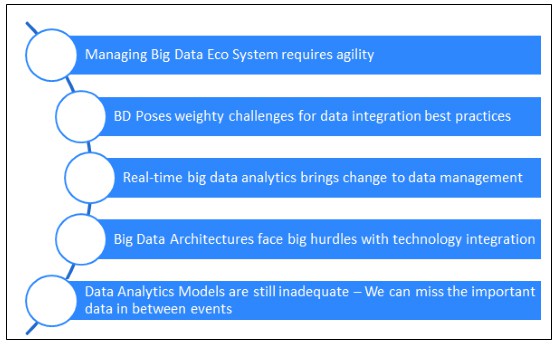
Figure 1: Critical Data Challenges
Managing Big Data Eco Framework requires dexterity in the midst of interruptions

Figure 2: Big Data Eco Framework
The demand for instant data access, regardless of whether by mobile applications or back-end machine learning frameworks, implies that data management systems must be agile. Common challenges of big data include fragmented systems, inconsistent data quality, and difficulty in managing both structured and unstructured sources at scale. These big data issues and challenges often become more visible when teams try to move from experimentation to production.
Big data management systems also need to be viewed as delivery systems, and the data they deliver must be valid for the models to work. That requires data specialists to spend a significant portion of their time investigating raw data before transforming it into machine learning algorithms. Thus, preparing the data for further processing often becomes as challenging as the actual analysis of the data itself.
Companies that use their big data ecosystem divert data lakes toward developing new strategies, products, and revenue streams; in the process, they smash their old business patterns.
Big Data poses profound difficulties for data integration best practices

Figure 3: Data Integration
Data consolidation framework needs more energy to deal with Big Data:
The growing adoption of stream processing devices puts heavy pressure on the IT team to rev up the data integration process to real-time speeds. Without more extensive integration capabilities, organizations cannot fulfill future requirements for big data analytics and real-time operations.
One of the biggest technical challenges of big data is integrating data from multiple sources fast enough to support analytics and downstream decision-making. In many cases, the right solutions for big data depend on combining batch and streaming pipelines with strong governance and automation.
Data Synchronization and consistency:
In the conventional extract, transform and load approach to data integration, the greater part of the data is brought to a staging area and synchronized as the data sets are processed in preparation for loading into the target system. However, as the number of origination points expands and the speed at which data is produced and delivered increases, it turns out to be more challenging to deal with the synchronization process. Capabilities of ETL tools to handle structured and unstructured data and deliver those in real-time or near real-time becomes key.
Real-time big data analytics conveys change to data administration

Figure 4: Real-time Big Data Analytics
The state of data administration keeps on changing, frequently determined by companies' grip of real-time big data analytics. Data preparation was once a much simpler discussion, but data is no longer taking a one-way path ending in a data warehouse. Instead, it is a part of an ongoing real-time system.
The technologies are complex. The streaming analytics engines that act on predictions and make fast recommendations involve many moving parts, both in terms of data ingestion and processing. These moving parts incorporate messaging frameworks, data streaming, in-memory analytics, and so on.
These big data analytics challenges are especially difficult when organizations must deliver near real-time results for customer-facing applications. To address this, teams often need modern pipelines, observability, and processing layers that support continuous ingestion and faster decision cycles.
The underlying complexity in new component compounding makes data management a more uncertain endeavor. Wisely selecting and combining these components is a daunting task. Knowing where best to apply the technology is challenging, too
Big data architectures confront huge obstacles with technology consolidation

Hadoop and all the related technologies empower organizations to outline big data environments that meet their specific requirements. In any case, assembling everything is complex.
Finding and deploying the right big data technologies within the expanding Hadoop ecosystem is a lengthy process frequently measured in years unless corporate executives throw ample amounts of money and resources at projects to speed them up. Missteps are common, and one company's architectural structure won't really mean different associations, even in a similar industry.
There is no easy-to-apply technology formula to follow. "Depending on the use case or user, different tools have to be chosen. With a host of options available in the technology stack across data ingestion, processing, and presentation layers, choosing the most appropriate technology/tool itself demands a lot of deliberation. The scarcity of Subject Matter Experts (SME) in some of those niche areas poses another challenge.
A major part of big data infrastructure challenges is deciding when to use Hadoop-based systems, distributed compute engines, or cloud-native platforms. The best big data technologies & solutions usually depend on the use case, the available skills, and the level of scale required.
In spite of building a multifaceted big data architecture with more technology components, real data analysis promptly continues to be a major obstacle.
70% of Hadoop installations will fall short of their cost savings and revenue generation goals due to a combination of inadequate skills and technology integration difficulties.
Data Analytics Models are still inadequate
While many companies now use data analytics models to predict future customer behavior or real-time data to make business decisions rapidly, companies may sometimes be missing key moments to gather analytics data.
Organizations also face challenges with big data analytics when data is missing from the “in-between moments” that reveal behavior between key events. Solving this often requires better sensor coverage, stronger event tracking, and more flexible analytics models.
A key overlooked area from which to gather analytics data is the "in-between moments" moments that might take place between key events that could reveal important data.
For example, take the case of deliveries (packages) in transit. We can track a package on Amazon.com. What about the events that happen between those drop-off points? Places where we are noticing the damage that's occurring regularly.
Ingesting data from devices such as Smart Watch devices or IoT devices can pose issues.
Data Visualization methods are problematic. We are dealing with data in new ways and in real time. But we tend to render our visualizations of data in old-fashioned ways: We use static graphs. We need a better visual paradigm for rendering time series information
How Data Challenges Affect Business
- Big Data makes data preparation steps more confounded to explore. One size fits all approach may not work in data preparation
- Companies need to ensure that the data they collect and analyse meets a specific level of quality and reliability for it to be trustworthy. Data capturing is an area that needs more focus
- Building big data architectures can be tedious and trying initially
- Deployment of big data systems stalls due to their complexity. Lack of big data skills when deploying a Hadoop environment affects usability and acts as a hindrance while leveraging the passive data sets
- Ingesting the data is the most challenging part of big data applications. Being able to pull growing amounts of data into the vendor’s big data architecture without any missteps is crucial for the success of a big data project
- Once data ingestion is complete, master data sorting to define different governance policies is another challenge
For companies just starting to collect and use big data, the biggest issue is often not volume alone but the ability to make the data reliable, searchable, and usable for decision-making. This is where big data best practices around quality, governance, and architecture become essential.
Big Data Solutions
Figure 6: Big Data Solutions
Effective big data solutions usually start with centralized metadata, standardized governance, and scalable pipelines for ingestion and analysis. The most successful solutions for big data also support visualization, self-service access, and clear ownership across teams.
- Create a centralized metadata store that can be accessed by all the major systems touched by big data
- Well-managed metadata and well-managed big data are inseparable. Clean, well-defined metadata has a significant effect in delivering actionable business intelligence results
- Big data management systems also need to be viewed as delivery systems, and the data they deliver must be valid for the models to work.
- Visual data exploration is a key step for deeper analysis. Good analytics dashboards turn BI data into actionable information
Mastech Digital Approach to Big Data Solutions
Mastech Digital provides Big Data Solutions, such as a managed Big Data Analytics Hub solution, AllSight Customer Intelligence Management (CIM) System. The Big Data Analytics hub enables customers to consolidate multi-channel data into a single source. AllSight CIM delivers Enterprise Customer 360.
Mastech-style big data industry solutions are most effective when they combine data consolidation, customer intelligence, and modern analytics workflows in one ecosystem. This helps organizations move from raw data collection to business-ready insight faster.
Big Data Analytics Hub
- Governed, managed, and self-sufficient data lake
- Seamless interaction with varied big data sources
- Modernized self-serve analytical platforms
- Built on robust big data technologies
- Plug and play with BI and Analytics Systems
AllSight Customer Intelligent Management (CIM) System
- Pre-built, with modern technology to deliver an intelligent Customer 360-degree view
- Ingests raw data, at the level of the individual, be it structured or unstructured, synthesizes it into larger customer records by stitching the tiny fragments of data together, reasons on that data by drawing inferences, enriches the data, makes predictions of future events, recalls customer information on demand, and learns continuously to evolve and improve on data
- Delivers actionable customer intelligence to all marketing users. Marketers, Customer Service, and Sales get access to complete and relevant customer data in real time
- Understands and synthesizes all fragments of customer data in data lakes, creates a clear customer 360-degree view, and adds analytical enrichments to customer 360, which can then be used by the customer-facing systems in the organization
- Manage and understand any form of customer data, and assign a confidence score to every piece of customer data. It uses Genetics Algorithm to understand expected user behavior and improve its performance progressively
- Omni-channel Personalized Care - AllSight can understand the entire customer journey, present that to your customer care users, and even predict the next steps in the customer journey
- Complete understanding of the customer to an organization’s sales team, linking all data sources into a cohesive view of customer accounts and contacts
When to use big data solutions?
Businesses should consider big data solutions when they need to process high-volume, high-velocity, or highly diverse data that traditional systems cannot handle efficiently. These platforms are especially useful for customer analytics, IoT, real-time monitoring, and large-scale personalization use cases.
Conclusion
Our diverse expertise in the Big Data Space has helped global enterprises to overcome their challenges in their Big Data initiatives.
Related Webinar