
The Blind Spot in Healthcare AI
Most health systems will tell you their data is in good shape. They have a data lake. They have an EHR integration. They have a governance policy. And in many cases, they have already run a successful AI pilot. The numbers looked promising, the steering committee was impressed, and the business case was approved for broader rollout.
Then production happened.
The model that performed well in a controlled experiment started drifting within weeks. The clinical team lost confidence in its outputs. The data engineering team spent more time firefighting inconsistent feeds than building new capabilities. And somewhere in the post-mortem, the conclusion was that the model needed retraining, or the vendor needed replacing, or the use case was simply harder than expected.
The actual problem was almost never the model. It was the data underneath it, and specifically the mismatch between what AI workloads require from clinical data and what most healthcare data environments were actually built to deliver.
This article is not about data quality in the traditional sense of fixing nulls and deduplicating records. It is about the structural requirements that AI imposes on clinical data, why those requirements are harder to meet in healthcare than in any other industry, and what production-grade data infrastructure looks like when it is built on the Databricks Data Intelligence Platform.
Clinical Data Through the Lens of AI
Reporting and AI infrastructure both consume the data from the same underlying systems and produce outputs that clinicians and administrators rely on. However, their data requirements differ significantly, and closing this gap needs more than making changes to existing data warehouses.
There are five structural properties that AI workloads require from clinical data. Each one is straightforward to describe challenging to implement in a healthcare context.
Freshness
A dashboard that refreshes overnight is acceptable for operational reporting. But an AI model making real-time recommendations about a patient in a clinical workflow cannot operate on yesterday's data. Features derived from vital signs, lab results, medication changes, or care team notes need to reflect the current state of the patient, and not a snapshot from twelve hours ago.
In healthcare, this freshness of data is complicated by the fragmented nature of source systems. EHR platforms, lab information systems, pharmacy systems, and payer claims feeds each operate on different latency profiles and export schedules. Building a unified, near-real-time feature layer across all of them is an engineering problem that most organizations have not yet solved.
Completeness
AI models are sensitive to missing data in ways distinct from SQL queries. A report can exclude patients with incomplete records and document the exclusion. But a sepsis prediction model trained on such incomplete records will learn incorrect patterns from the absence of data, producing outputs that may contain errors that are not readily apparent.
Clinical data is structurally incomplete by design. Clinicians document what is relevant to their workflow which means not every visit produces a structured problem list. And not every discharge produces a coded diagnosis. The gap between what is documented and what is clinically true is one of the defining challenges of healthcare AI, and it cannot be resolved by the model alone.
Semantic Consistency
The concept of readmission varies significantly across facilities, payer contracts, care settings, and departmental standards. Its definition may differ widely depending on the context, leading to multiple interpretations. When an AI model is developed in one environment and subsequently deployed in another, or when distinct teams within an organisation utilise varying definitions of the same metric, results cannot be reliably compared—even if they seem similar on the surface.
Clinical coding amplifies this problem. ICD-10 codes and SNOMED CT are applied inconsistently across facilities. Free-text notes carry information that structured fields do not capture. Building a semantic layer that produces consistent definitions across the entire organization is an essential prerequisite for AI.
Lineage Traceability
When a clinician questions the basis for a care recommendation, the organization needs to be able to reconstruct the reasoning. When a regulator asks which patients were included in a model's training data, the answer needs to be available within hours, not weeks. When a model begins producing unexpected outputs, the engineering team needs to trace those outputs back to the specific data version and pipeline state that produced them.
None of this is possible without end-to-end lineage that runs from the source record through every transformation, feature derivation, and model version to the final output. Most healthcare organizations have partial lineage at best, typically covering the reporting layer and not extending into the model layer.
Access-Aware Availability
Protected Health Information creates a constraint that no other industry faces at the same scale. Clinical data must be available to the AI workloads that need it while being inaccessible to workloads, users, and systems that do not. This enforcement needs to be automatic, consistent, and auditable. It cannot depend on application-level controls that vary across tools or on developer discipline to implement correctly in each new pipeline.
Access-aware availability means that the data layer itself enforces these rules, not the systems consuming it. The AI agent, the data scientist's notebook, and the population health dashboard all need to operate against the same data with the same access rules applied uniformly.
Where Most Health Systems Are Today
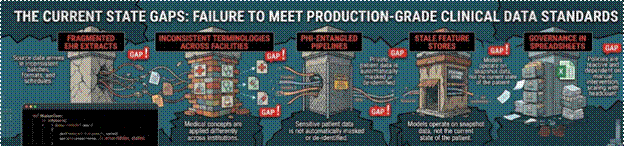
An honest assessment of the current state in most health systems reveals five recurring gaps. These are not edge cases or signs of poor execution. They reflect structural limitations in architectures that were designed for a different purpose.
Fragmented EHR Extracts
The dominant pattern in healthcare data integration is the nightly extract. HL7 v2 messages arrive in batches. FHIR APIs are called on a schedule. Flat files land in an SFTP folder at 2 AM. The resulting data lake contains a reasonable approximation of clinical reality as it existed at some point in the recent past, but it is rarely a coherent, queryable representation of the current state.
When AI pipelines utilize these extracts, they also inherit associated latency and potential inconsistencies. Features generated from batch-loaded data are inherently limited in freshness, a constraint that cannot be resolved through model optimization alone.
Inconsistent Terminologies Across Facilities
Health systems that operate across multiple facilities face significant challenges regarding semantic consistency. When facilities utilize separate EHR instances or different configurations of the same EHR platform, the resulting data often has varying code systems, value sets, and documentation practices for identical clinical concepts. As a result, feature engineering pipelines that function effectively with data from one hospital may produce invalid outcomes when applied to data from another hospital within the same network.
Most organizations deal with these issues by manual mapping processes, which are costly, time-consuming, and prone to becoming outdated as changes occur in source systems.
PHI-Entangled Pipelines
In many healthcare data environments, PHI is present throughout the pipeline by default. De-identification is applied selectively, often for specific downstream use cases like research, rather than enforced at the platform level. This means that every new AI workload requires a separate assessment of whether it is handling PHI appropriately, and every new tool that touches the data introduces a new surface for potential exposure.
The result is a governance model that is reactive rather than systematic, dependent on individual engineers making correct decisions rather than on platform controls that enforce the correct outcome automatically.
Stale Feature Stores
Organizations that have invested in feature stores for clinical ML often discover that keeping those features current is harder than building them in the first place. Features derived from complex clinical logic require careful point-in-time semantics. A feature representing a patient's most recent HbA1c result needs to reflect what was known at the time a clinical decision was made, not what was documented afterward.
Without strong infrastructure to ensure feature freshness and point-in-time accuracy, models risk data leakage by learning from future data leading to invalid metrics and underperformance in real use.
Governance in Spreadsheets
The most basic gap is also the most prevalent. Governance policies are documented, while data dictionaries are kept in spreadsheets. Access control choices are handled through tickets and emails. As AI workloads multiply, the disconnect between written policies and implemented controls expands significantly and often goes unnoticed.
Without built-in platform governance, scaling depends on staff rather than data. New use cases need manual review, and every tool demands fresh access control integration. An organization managing few AI workloads today will not be able to scale higher with the same approach.
The Databricks Architecture That Closes Each Gap
The Databricks Data Intelligence Platform addresses these five gaps through a set of capabilities that work together as an integrated system rather than as individual features. The distinction matters because the gaps described above are not independent problems. A freshness solution that bypasses access controls creates exposure. A lineage system that does not extend into the model layer produces incomplete forensics. The value of Databricks in this context comes from the coherence of the platform, and not from any single component.
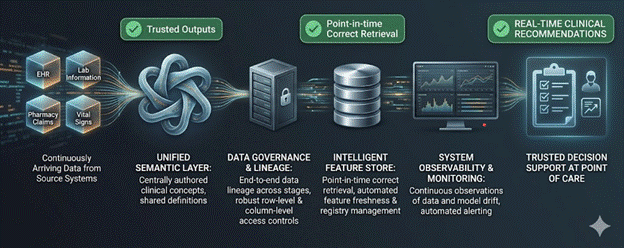
Fig 2 - Unified Databricks Architecture For Production-Grade Clinical Data
Freshness Through Continuous Ingestion
Auto Loader provides incremental, schema-aware ingestion from cloud storage, HL7 feeds, and FHIR APIs with built-in checkpointing. Clinical data arrives continuously rather than in scheduled batches, and schema evolution is handled automatically as source systems change their output formats. Downstream pipelines built with Databricks' declarative pipeline framework, Lakeflow, declare data quality expectations at the ingestion boundary, meaning that incomplete or malformed records are identified and quarantined before they reach the feature layer, and not discovered after a model has trained on them.
This combination shifts the data infrastructure from a batch architecture to a streaming architecture without requiring healthcare organizations to rebuild their ingestion patterns from scratch.
Semantic Consistency Through a Unified Semantic Layer
The AI/BI Semantic Layer in Databricks provides a single, governed location for defining clinical concepts that are shared across all workloads. Readmission, length of stay, risk score, care gap, and any other metric the organization operates on is defined once and consumed consistently whether the consumer is a dashboard, a data science notebook, or an AI agent making a care management recommendation.
For multi-facility health systems, this means that the definition of a clinical concept can be authored centrally and applied uniformly across facilities that may have different source system configurations. The alternative, allowing each team to define metrics locally, produces the fragmentation that makes cross-facility AI comparison meaningless.
Delta Sharing extends this consistency across organizational boundaries, enabling governed data exchange with payers, research partners, and care network members without creating copies of data that immediately begin diverging from the source of truth.
Point-in-Time Correctness in the Feature Layer
Mosaic AI Feature Store provides a managed feature registry with point-in-time correct retrieval. When a model is trained on historical data, the feature store ensures that only information available at the time of each historical event is used, eliminating data leakage from retrospective documentation. When the same features are used for real-time inference, Online Tables provide low-latency serving with sub-100-millisecond response times suitable for clinical workflow integration.
The feature store also maintains a full registry of feature definitions, their lineage back to source tables, and the models that consume them. When a source system changes its output, the downstream impact on features and models is immediately visible rather than discovered through unexpected model behavior.
Lineage Across the Entire Stack
Unity Catalog maintains end-to-end lineage from source tables through transformations, feature derivations, model training runs, and deployed model outputs. MLflow extends this lineage into the experiment layer, capturing every model version, the exact dataset and feature set it was trained on, the hyperparameters used, and the evaluation metrics produced.
For a clinical AI team, this means that the question of which patients were in the training data for a given model version has a precise, queryable answer. For a compliance team responding to a regulatory inquiry, it means that the forensic work that previously took days of coordination can be completed in hours through a single query.
Access Controls as Platform Properties
Unity Catalog enforces row-level filters, column masks, and attribute-based access policies at the query execution layer, not at the application layer. Every query that touches PHI is evaluated against the applicable policy regardless of which tool, notebook, dashboard, or AI agent issued it. There is no path through the platform that bypasses these controls.
For AI workloads specifically, this means that a care management agent operating under a service principal is subject to the same access rules as a human analyst. The agent cannot access records outside its permitted scope, and every access event is written to the system audit tables. The organization does not need to build separate governance for AI workloads because the platform treats them identically to any other principal.
Lakehouse Monitoring operates continuously across both the data layer and the model layer, tracking statistical drift in data quality metrics and model performance and generating alerts when measured properties move outside defined tolerances. For clinical models operating in production environments, this continuous observation is the difference between detecting model degradation before it affects patient care and discovering it after a clinician raises a concern.
Sequencing the Path to Production Grade
The distance between where most health systems are and where AI requires them to be is real, but it is a sequenced engineering problem rather than an insurmountable one. The organizations that close it fastest are not necessarily those with the largest data teams or the highest technology budgets. They are the ones that correctly diagnose which gaps are limiting their AI workloads and address them in the right order.
The order of implementation is crucial. Investing in an advanced feature store before the ingestion layer is delivering fresh, consistent data results in a feature store full of stale, unreliable features. Similarly, deploying AI agents without proper access-aware governance may lead to agents that either cannot access the data they need or access more than they should. While the platform supplies the required components, it is the architecture that determines their effectiveness and value.
There is also a compounding effect to getting this right. An organization that builds a production-grade clinical data foundation on Databricks is not building it for a single AI use case. Every workload that follows inherits the same freshness, semantic consistency, lineage, and access controls. The cost of governance does not increase linearly with the number of AI workloads because the controls are enforced at the platform level, not implemented separately for each use case.
Governance programs relying on policies and spreadsheets lack this capability, making it essential to address these shortcomings at the platform level instead of using separate point solutions.
Defined Path Forward
For healthcare organizations actively deploying AI workloads, or planning to expand beyond initial pilots, the starting point is an honest assessment of whether the current data infrastructure meets the standard described in this article or not.
Our Databricks practice has developed a structured approach to support healthcare and life sciences organizations through this assessment and the remediation work that follows.
A focused engagement, typically conducted over four to six weeks, in which our team evaluates your current data infrastructure against the five properties outlined in this article and delivers a prioritized set of recommendations specific to your Databricks environment. The assessment covers ingestion latency and freshness, semantic layer maturity, feature store architecture and point-in-time correctness, lineage coverage across data and model layers, and access control enforcement at the platform level. The output is a concrete, sequenced roadmap for closing the gaps that are limiting your current AI workloads and creating the conditions for those that follow.
We would welcome the opportunity to begin that conversation. The health systems that reach production-grade clinical data infrastructure first will not just run better AI models. They will run the only AI models that clinical teams actually trust.