
Executive Summary
Business Problem and Opportunity
What is AI-driven OEE in MedTech manufacturing?
AI-driven OEE in MedTech is a closed-loop operating model that uses agentic AI on a governed lakehouse to convert OT, MES, and QMS data into real-time loss attribution, predictive maintenance, and validated yield decisions within 21 CFR Part 11 and ALCOA+ constraints.
MedTech manufacturing has entered a structurally different decade. Average selling prices on commodity devices are eroding 3–6% per year, raw-material and logistics volatility refuse to subside, and regulators are tightening expectations on data integrity, post-market surveillance, and supply continuity. At the same time, product portfolios are exploding: a single contract manufacturer of catheters, infusion pumps, orthopaedic implants, or in-vitro diagnostics can now run hundreds of SKUs per line, each with its own validated process, sanitation regime, and changeover playbook.
Against this backdrop, Overall Equipment Effectiveness (OEE), the product of Availability × Performance × Quality has migrated from a plant-floor KPI to a CFO-level conversation. Every percentage point of OEE in a regulated environment is worth millions in throughput, working capital, and avoided capital expenditure. Yet most MedTech sites remain stuck in the 45–70% OEE band, well short of the 85% world-class benchmark. Two decades of Lean and Six Sigma have wrung out the obvious losses; what remains is the long tail of micro-stops, speed loss, sanitation overhead, and quality holds that no spreadsheet can decode in real time.
THE THREE-SHIFT THESIS
Manufacturing is shifting along three axes at once: from dashboards to decisions, from deterministic automation to agentic reasoning, and from data warehouses to data intelligence platforms.
This article lays out a technical blueprint for the next leap: agentic, AI-driven OEE built natively on the Databricks Data Intelligence Platform. The mechanism comprises a governed and integrated collection of platform capabilities including Lakeflow Declarative Pipelines, Unity Catalog, Delta Lake, MLflow 3.0, the Databricks Agent Framework, Vector Search, and Lakebase Postgres which are systematically connected in a closed loop to sense, reason, recommend, and act, while ensuring the preservation of all GxP audit evidence.
The problem space and agentic intervention
a. Why do traditional OEE programs stall in regulated plants?
Because the data is fragmented across PLC, MES, QMS, LIMS, and EAM; loss codes are entered by hand; maintenance is reactive; and every optimization triggers re-validation friction - issues that no dashboard alone can solve.
Five root causes are predictable and reinforce each other:
- Fragmented data silo: OT telemetry sits in historians (PI, Aveva); MES events in Rockwell, Siemens Opcenter, or Camstar; QMS deviations in Veeva, MasterControl, or TrackWise; ERP in SAP S/4HANA. Each system has its own clock, taxonomy, and access boundary.
- Manual loss-code attribution: Operators tag downtime from a drop-down at end-of-shift; two operators pick different codes for the same micro-stop, and the same operator picks differently on Monday versus Friday.
- Reactive maintenance: Without a continuously trained model of asset health, teams oscillate between time-based PMs (over-service) and run-to-failure (catastrophic, unplanned events).
- Variant-heavy SKUs: High-mix portfolios mean no two runs look alike; aggregated baselines cannot separate "this product runs slower" from "this asset is degrading".
COMPLIANCE PARADOX 2.0
Historically, validation friction killed agility. Agentic AI inverts the equation by making compliance evidence- lineage, MLflow traces, e-signatures, immutable audit logs, a continuously generated by-product of the runtime itself, not a separate documentation burden.
b. Why Agentic AI, Why Now
The last five years brought sensors, historians, and lake architectures to the shop floor. What was missing was a reasoning layer that could correlate vibration signatures, batch records, work-order history, planner constraints, and SOP language at the cadence of the line. Foundation models - governed, evaluated, and grounded on enterprise data finally close that gap. When those models are wrapped in agents that can call deterministic tools, respect Unity Catalog access policies, and route every consequential action through a human approver, the result is a closed-loop OEE platform that is both autonomous and audit-ready.
Solution Architecture overview
Which Databricks features power agentic OEE?
Delta Lake and Unity Catalog (governance), Lakeflow Connect and Declarative Pipelines (ingestion and ETL), Feature Store, MLflow 3.0 and Mosaic AI Model Serving (ML), Vector Search, AI Functions and Agent Bricks (agents), and Lakebase Postgres with Databricks Apps (operator UX and write-back).
The solution is built on the MedTech manufacturing using a five-layer architecture that progresses from raw OT ingestion through curated analytics to AI-powered agent applications. Each layer has a distinct responsibility; all are governed by Unity Catalog as the single control plane.
|
Layer |
Responsibility |
Key Capabilities |
|
Ingestion |
Land OT telemetry, MES events, QMS records, and ERP transactions into Delta Lake with schema enforcement. |
Lakeflow Connect, Auto Loader, Kafka |
|
Medallion |
Progressive refinement from raw Bronze through conformed Silver to business-ready Gold. |
Lakeflow Declarative Pipelines, Delta Lake |
|
Governance |
Unified access control, column-level lineage, classification tags, and audit logging across all data and AI assets. |
Unity Catalog, Lakehouse Monitoring |
|
Agent |
Five specialised AI agents reason on Silver/Gold features, invoke tools, and route actions through human-approval gates. |
Databricks Agent Framework, MLflow, Model Serving |
|
Consumption |
Role-based OEE dashboards, natural-language Genie queries, Databricks Apps for HITL approval, and EHR/MES write-back. |
Databricks SQL, Databricks Apps, Genie |
ONE COMPOSABLE RUNTIME
These are not isolated services bolted together. Unity Catalog functions, MLflow traces, and Lakeflow expectations form a single composable substrate where data, models, and agents share one permission model and one lineage graph.
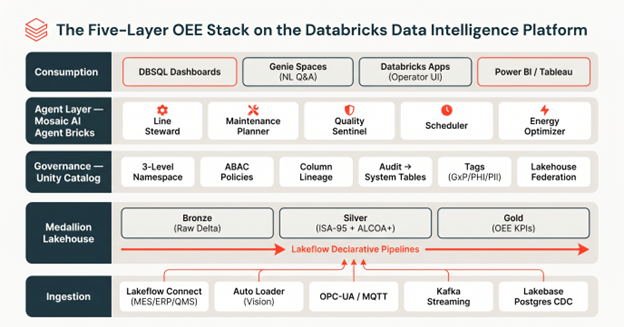
Figure1 - The Five-Layer OEE Stack on the Databricks Data Intelligence Platform - consumption, agent, governance, medallion, and ingestion layers as a single composable runtime
Data Architecture: The Medallion Design
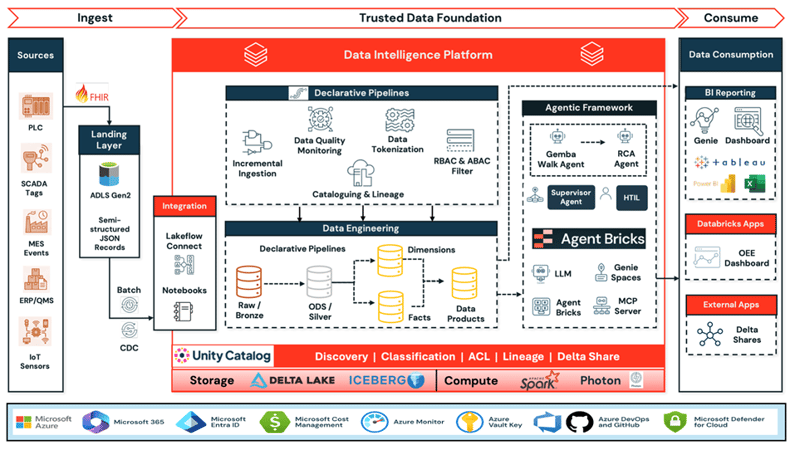
Figure 2- The Medallion design for OEE
Design Principles
The medallion pattern (Bronze → Silver → Gold) is the canonical Databricks data design. Applied to OEE, it provides the structural discipline that lets engineers and auditors look at the same data and reach the same conclusions. Four principles govern the design:
- One copy of the truth - Every OT signal, MES transaction, QMS record, CMMS work-order, and ERP movement lands once in the lakehouse and is governed by Unity Catalog. No shadow lakes, no agent-private stores.
- Open formats by default - Delta Lake under the hood; no proprietary lock-in. In MedTech, data must be retrievable for the regulated lifetime of the product
- Compliance as a schema property - Attributable, Legible, Contemporaneous, Original, Accurate are encoded directly in the Silver layer schema, not retrofitted in audit tooling.
- Data quality as contracts - Lakeflow expectation clauses are first-class data-quality contracts that emit metrics into Lakehouse Monitoring and that auditors can inspect as evidence of validated transformation logic.
The Agentic Layer
How do MedTech AI agents stay compliant?
Each agent is registered as a Unity Catalog governed function with column-level lineage, MLflow 3.0 traces, ABAC policies, and an enforced human-in-the-loop e-signature gate inside a Databricks App making every action attributable, contemporaneous, and auditable.
a. Design Rationale: Narrow Agent Mesh
The architecture comprises of a mesh of narrow agents, each with a bounded context, a tested toolset, and a defined human-approval contract.
|
DESIGN PRINCIPLE The lakehouse is the shared memory. Agents are the reflexes. Replace the reflexes tomorrow and the institutional knowledge, every loss code, every RUL prediction, every approval remains intact in Delta tables, owned by the manufacturer, not by any vendor. |
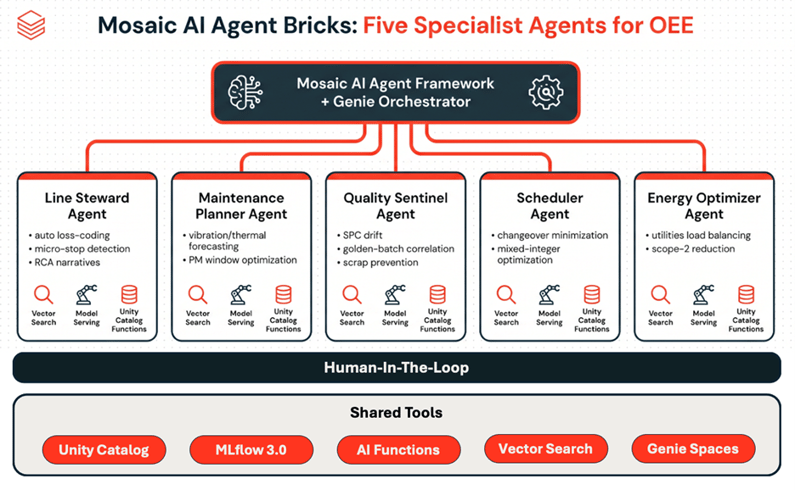
Figure 3 - OEE specialist agents on Mosaic AI AgentBricks sharing Unity Catalog and AI tools gated by human-in-the-loop controls
b. Key Agent Workflows: Gemba Walk and Root Cause Analysis
Let’s deep dive into two high-value workflows delivered through the agent layer - the Gemba Walk and Root Cause Analysis (RCA). These are not separate agents, but structured interaction patterns built on top-of-the-Line Steward and Quality Sentinel agents respectively, using the same Databricks Agent Framework runtime and the same Unity Catalog Gold tables as retrieval context.
Gemba Walk Workflow
Plant managers and shift supervisors conduct equipment walkthroughs using the Databricks App. The agent surfaces live OEE context, structured SOP guidance, and open work-order status at each device stop and guides the conductor through structured observation capture.
|
Step |
Agent Action |
Output |
|
1. Walk Initiation |
Agent retrieves facility layout and active shift context |
Schedule, Location context |
|
2. Device Stop |
Agent surfaces OEE score, alarm history, and last maintenance for selected device |
Device, Observation, Alarm |
|
3. Observation Capture |
Plant manager describes finding; agent structures it against the loss-code taxonomy |
Structured observation record |
|
4. Incident Creation |
Agent creates incident and routes to Quality Sentinel queue with severity classification |
Incident record + Task assignment |
|
5. Walk Summary |
Agent generates structured Gemba Walk report for the shift with prioritised actions |
Walk report in Lakebase + Delta |
Root Cause Analysis Workflow
Following a Gemba Walk finding or an automated alarm trigger, the Quality Sentinel agent assists quality engineers through the full RCA lifecycle right from evidence aggregation to CAPA recommendation in a fraction of the manual time.
|
Step |
Agent Action |
Output |
|
1. Queue Review |
Agent presents prioritised incident queue with device history context |
Ranked incident list |
|
2. Evidence Aggregation |
Agent pulls device telemetry, alarm log, maintenance records, and calibration data from Gold tables |
Evidence package |
|
3. Hypothesis Generation |
Agent generates ranked root-cause hypotheses from device telemetry patterns and similar historical incidents |
Ranked hypothesis list |
|
4. Root Cause Confirmation |
Engineer confirms or adjusts root cause; agent records the decision with full evidence citations |
RCA record |
|
5. CAPA Creation |
Agent recommends corrective actions with owner and due-date suggestions; engineer approves and assigns |
CAPA plan + Task assignments |
|
6. Report Generation |
Agent produces full structured RCA report including timeline, contributing factors, root cause, and lessons learned |
RCA report document |
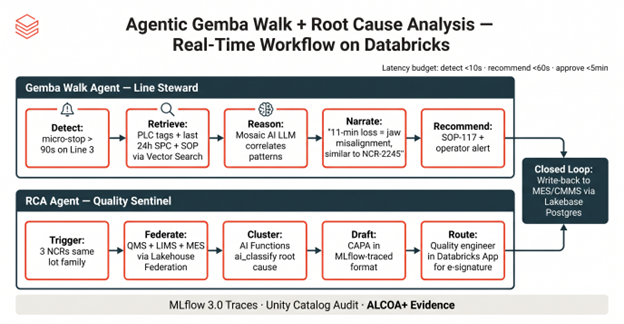
Figure 4- Illustrative Agentic Gemba Walk + Root Cause Analysis - parallel swimlanes converging on a closed-loop write-back to MES/CMMS.
Agents recommend; humans approve all consequential actions. The approval gate is a first-class architectural component - a Databricks App step that captures an e-signature, persists the record to Lakebase, and links back to the underlying recommendation version. The Databricks Agent Framework's automatic authentication passthrough means each agent executes under the approving user's Unity Catalog permissions when it touches downstream systems, so write-back inherits the same compliance posture as a human action through a validated UI.
Predictive Maintenance MLOps
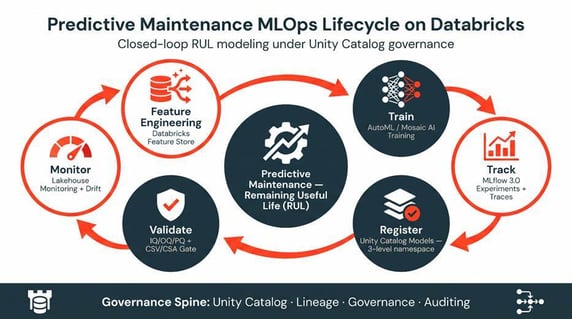
Figure 5 - The Predictive Maintenance MLOps Lifecycle on Databricks, governed end-to-end by a Unity Catalog spine for lineage, governance, and auditing
How do you validate non-deterministic AI models for GxP?
Apply a risk-tiered CSV/CSA framework where evidence intensity scales with closed-loop authority from a model card for advisory use up to full IQ/OQ/PQ for closed-loop control.
Predictive maintenance is the highest-ROI use case in most MedTech OEE programmes, because availability loss dominates the OEE gap and failures on validated equipment carry both schedule and quality penalties. The Databricks RUL lifecycle runs end-to-end under Unity Catalog governance. Point-in-time-correct features (vibration RMS, motor current entropy, throughput per cycle, MES context) are engineered on the Feature Store and materialised to both Lakebase and Delta. Models such as gradient-boosted survival, LSTMs, or time-series transformers are trained on Mosaic AI and tracked in MLflow with full parameters, metrics, git SHA, dataset hash, and GenAI traces. Each model is registered under a three-level namespace with lineage to its training data, then passed through a risk-based CSV/CSA gate where the model card, data sheet, performance envelope, and drift baseline are e-signed in a Databricks App. Approved versions deploy on Mosaic AI Model Serving (CPU or GPU, provisioned throughput) behind Unity Catalog access controls, and Lakehouse Monitoring tracks feature and prediction drift with ground-truth back-fill routing alerts to both the data-science team and the Maintenance Planner agent.
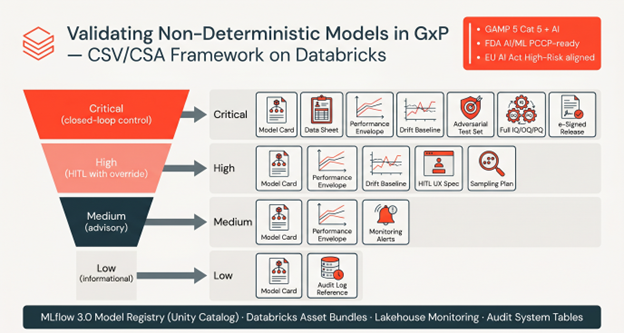
Figure 6 - Validating Non-Deterministic Models in GxP - a risk-tiered CSV/CSA framework
Governance and Compliance
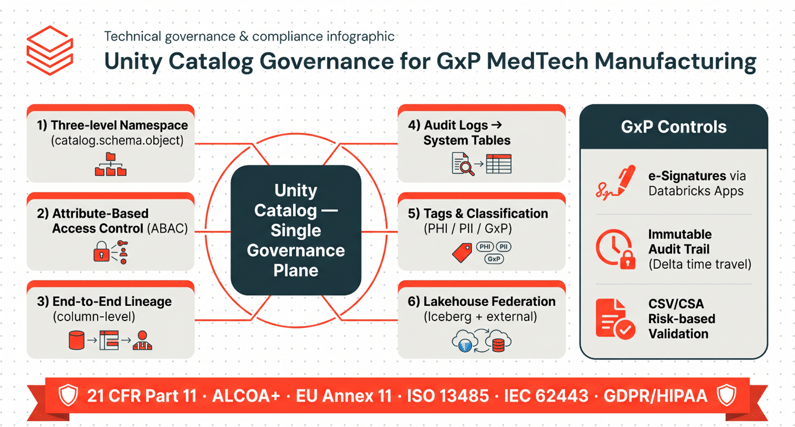
Figure 7 - Unity Catalog as the Single Governance Plane for GxP MedTech Manufacturing
Is Unity Catalog enough for 21 CFR Part 11 compliance?
Unity Catalog provides the technical substrate such as namespace isolation, ABAC, lineage, immutable audit, and federation but Part 11 also requires e-signature procedures, training records, and validated change control, which Databricks Apps plus Asset Bundles operationalize end-to-end.
a. Unity Catalog as the Single Governance Plane
Unity Catalog isn't bolted onto the platform; it's how the platform is designed. Attribute-based access control (ABAC) drives tag-based dynamic policies e.g. a qa_reviewer can read GxP-tagged columns only when the row's site matches their assigned site. Column-level lineage traces every Gold KPI back to its source Bronze tags automatically, with no diagrams to maintain. Audit logs flow into system.access.* tables - every read, write, model invocation, and agent action is SQL-queryable and export-ready for audit packages. Classification tags (PHI, PII, GxP, SoX, IP-restricted) drive automated discovery and policy enforcement. And Lakehouse Federation extends the same policy and lineage layer to external Iceberg, Snowflake, Postgres, and SQL Server tables without copying them.
POLICY AS CODE
When ABAC, tags, lineage, and Databricks Asset Bundles converge, GxP policy becomes executable artefacts in Git, not PDFs in SharePoint. This is the unlock for regulated manufacturing AI at scale.
b. Change control via Databricks Asset Bundles
Databricks Asset Bundles (DABs) are Git-versioned, declarative infrastructure-as-code definitions for every platform artefact - pipelines, jobs, models, agents, dashboards, and access policies. In a regulated MedTech environment, every change to any artefact is a pull request with a required reviewer, every deployment is a signed release tagged in the repository, and the CSV/CSA evidence package is produced as a natural by-product of the development workflow rather than a manual documentation exercise.
This inversion is the strategic consequence of the architecture: because every transformation is declarative, version-controlled, and lineage-tracked, risk-based CSV/CSA can scope its validation work to the minimum surface that affects product quality.
Frequently Asked Questions
Most regulated MedTech plants operate in the 45–70% OEE band, well below the world-class 85% benchmark. With a properly scoped agentic OEE programme on Databricks such as real-time loss attribution, predictive maintenance, and AI-assisted root cause analysis, manufacturers typically see a 5–15 point OEE uplift inside 6–12 months. Payback is achievable faster when the lakehouse already exists and ingestion is greenfield.
A traditional MES analytics module is closed, vendor-specific, and limited to MES-resident data. Databricks unifies OT telemetry, MES events, QMS deviations, ERP transactions, vision inspection images, SOPs, and batch records under a single governed lakehouse. Lakeflow Connect ingests them, Delta Lake stores them in open formats, Unity Catalog governs them with column-level lineage and ABAC, and Mosaic AI reasons across them. The difference is open architecture, real AI, and one governance plane, not a bolt-on dashboard.
Unity Catalog classifies sensitive columns through tags such as PHI, PII, and GxP, and enforces them dynamically via attribute-based access control. A device-utilization analyst can read aggregated metrics while PHI columns are masked or filtered at query time without copying data. Column-level lineage proves which Gold KPIs touched PHI, and the audit log streams every read, write, and model invocation into system tables, satisfying HIPAA and GDPR review without separate audit instrumentation.
Lakebase Postgres is the managed OLTP database that complements the analytical lakehouse. It stores low-latency application state such as operator approvals, e-signatures, work-order drafts, and HITL session context and synchronises bidirectionally with Unity Catalog governed Delta tables. The agent layer reads Lakebase for live workflow state and writes back operator decisions, closing the loop without round-tripping through MES. For Databricks Apps powering the operator UI, Lakebase delivers sub-50ms reads on transactional records.
FHIR is the interoperability bridge: pushing device-utilization summaries to clinical systems (Epic, Cerner) for patient scheduling, and pulling structured quality and maintenance records from EHR-connected device management platforms. Resources such as Device, Observation, Task, and CarePlan map cleanly to OEE entities, and the dbignite library on Databricks Labs ingests FHIR bundles into Delta tables in a single call.