
Executive Summary
Medical device manufacturers face a data crisis that traditional master data management (MDM) systems find difficult to handle. Fragmented material records, duplicate customer accounts, and schema mismatches in integration hubs directly threaten regulatory compliance, patient safety, and supply chain continuity with FDA enforcement actions and surgical delays as real consequences.
This article presents a target-state data modernization strategy for large orthopedic and implantable device manufacturers. By transitioning to Medallion architecture, organizations can resolve critical data mapping failures across four core MDM domains: Material, Customer, Vendor, and Finance establishing a unified gold layer that feeds all downstream enterprise applications with complete, compliant, and deduplicated master data.
Why data modernization for a medical device supply chain is different
Data management in manufacturing typically centers on standard supply chain metrics. However, in the highly regulated medical device sector, product data represents both a lifeline for patient safety and a legal requirement for market authorization. A single master data failure can result in compliance violations, supply chain bottlenecks, or delayed surgical interventions.
Medical devices such as ankle and hip replacements involve layers of multifaceted data. Managing this requires an ecosystem capable of handling continuous schema evolution without affecting downstream integration hubs. Furthermore, as regulatory bodies including the FDA, EMA expand tracking requirements, legacy systems designed years ago are struggling under the weight of new data types and complex relational structures.
|
Regulated product data requires both operational trust and auditability. If data quality is compromised in the integration layer, the entire supply chain inherits the compliance risk. |
Core data domains
A typical large orthopedic implant manufacturer typically governs four interconnected MDM domains: a Material Master anchoring orthopedic products, UDI labels, and FDA approval milestones; a Customer Master tracking hospital networks and authorized purchasing entities; a Vendor Master governing upstream supplier traceability for implantable device components; and a Finance Master linking billing, procurement pricing, and tax hierarchies to regulatory and customer data.
Modernizing the data architecture requires a holistic view of the enterprise. The target state unifies four core domains:
- Material Master: The anchor domain containing orthopedic products, UDI labels, sterilization protocols, ROBAR compliance flags, and FDA multi-step approval milestones. This domain is the most complex in terms of attribute density and regulatory sensitivity. Every record must be traceable from raw material sourcing to implantation.
- Customer Master: Detailed tracking of hospital networks, integrated delivery networks (IDNs), authorized purchasing entities, and surgeon buying patterns. This domain drives commercial accuracy with incorrect customer records leading to misapplied contract pricing, failed chargeback reconciliation, and inaccurate sales crediting.
- Vendor Master: Upstream supplier data critical for traceability of raw materials used in implantable devices. In a post-DSCSA world, vendor master integrity is not merely operational, it is a regulatory requirement. A single unresolved duplicate vendor record can break the chain of traceability required for FDA device recalls.
- Finance Master: Billing, procurement pricing, and tax hierarchies linked directly to regulatory and customer data. This domain connects commercial outcomes to compliance obligations.
| Domain | Primary Risk if Unmastered | Key Downstream Consumer |
|---|---|---|
| Material Master | FDA compliance failure, surgical delay | ERP, Regulatory Reporting |
| Customer Master | Revenue leakage, contract non-compliance | CRM, Order Management |
| Vendor Master | Recall traceability breakdown | Procurement, Quality |
| Finance Master | Pricing errors, government penalty | Finance, Compliance |
The Current State Problem: Eight Compounding Challenges
A large orthopedic device manufacturer typically runs SAP MDG, a CRM, an ERP, third-party regulatory submission tools, and supplier portals simultaneously. Each maintains its own data model and its own version of the truth. The root cause is architectural, not a failure of any individual platform, but a failure of how those platforms have been assembled.
|
The problem is not the systems. It is the architecture that connects them. Fragmented platforms, rigid integrations, and absent governance combine to create a compliance liability that no single system upgrade can resolve. |
1. Multiple Data Platforms in Silos
The same hospital network exists under three different names across MDG, CRM, and ERP. The same surgical implant carries different SKU formats in the regulatory system and order management system. When a recall is triggered, identifying affected lots across siloed platforms becomes a multi-week manual exercise in an environment where speed is a regulatory obligation.
2. Integration and Interoperability Gaps
Point-to-point, hard-coded integrations face a binary choice when a new regulatory attribute arrives: break the downstream mapping or silently drop the field. In most legacy architectures, fields are dropped without triggering an error. The integration layer becomes the primary mechanism by which compliance risk is distributed across the enterprise.
3. Inconsistent Data Governance
Master data records are created by multiple teams such as regulatory affairs, supply chain, commercial, finance each operating under different definitions of completeness. When a quality exception is identified, a missing sterilization protocol, an unvalidated UDI, there is often no named owner responsible for resolving it. Unowned exceptions are the single most common cause of Gold layer degradation post-launch.
4. Role-Based Access and Data Security Gaps
Access controls in legacy architectures are managed at the application layer, not the data layer meaning a user with ERP access can view data their role has no business need to see. This creates compliance exposure and audit risk when regulatory bodies investigate recalls.
5. Performance and Latency Constraints
Legacy batch cycles such as nightly syncs, weekly reconciliation jobs are incompatible with just-in-time implant logistics and same-day surgical scheduling. When a supplier quality hold is placed on a raw material lot, affected SKUs must be flagged within hours, not days. Latency in a surgical supply chain is a patient safety gap, not a performance inconvenience.
6. Skills Gap and Organizational Readiness
The talent profile required such as regulatory domain expertise combined with data engineering, cloud proficiency, and AI/ML literacy is scarce. Canonical data models are often designed by IT teams without regulatory input; match/merge models are deployed with uncalibrated default thresholds. The architecture is technically deployed but operationally ineffective.
7. Constraints and Attribute Complexity
A single implantable device requires tracking of product names, SKUs, dimensions, material composition, ROBAR compliance flags, UDI labels, single/multi-use designations, sterilization protocols, country-specific selling restrictions, and multi-step FDA approval statuses tied to expiry dates. This attribute density creates fragility with the majority of material master integration failures stemming directly from UDI schema drift when new format requirements outpace integration hub updates.
8. Integration Hub Bottleneck
When dense, highly nested device data flows from SAP MDG into existing hubs, mapping failures are inevitable. Rigid, hard-coded hubs cannot absorb new data types — a revised FDA approval field or a new country restriction code frequently causes synchronization failures, data truncation, or silent truncation of critical attributes. The data reaching downstream applications is incomplete before anyone realizes it.
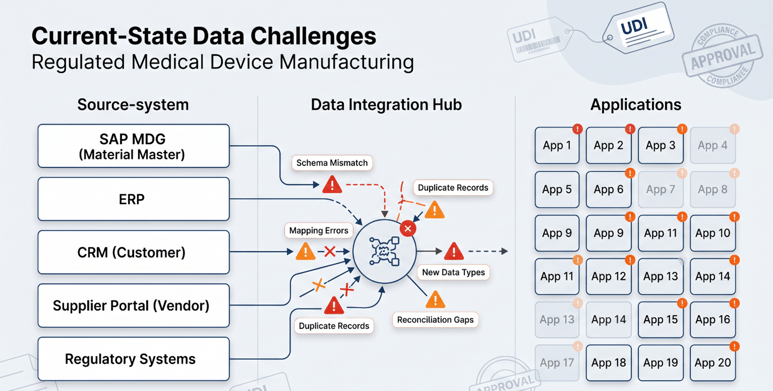
Figure 1: Current-state data fragmentation in a regulated medical device environment
Integrated target-state Architecture
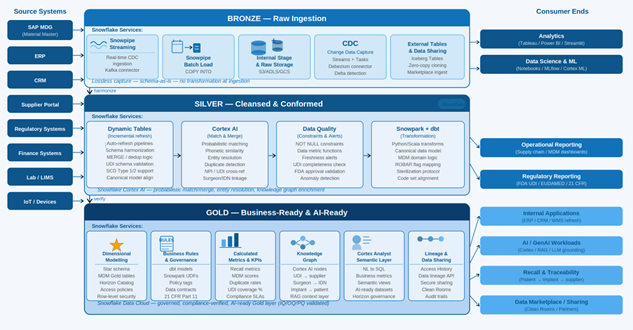 Figure 2: Integrated target-state Medallion Architecture on Snowflake
To resolve schema brittleness and ensure high data quality, leading organizations are abandoning siloed integration frameworks in favor of a unified data integration hub built on a modern cloud data platform. This centralization strategy brings critical domains such as material, customer, vendor, and finance into a single, highly governed ecosystem.
By adopting a Medallion Architecture, the data platform systematically refines information from raw ingestion to business-ready consumption. This gold layer then becomes the single source of truth, securely and accurately distributes data products to all downstream applications, including ERP, CRM, regulatory reporting, and supply chain planning systems.
Medallion Architecture in Action
Snowflake provides scalable storage, compute, and native data services foundation. The intelligence of the Medallion Architecture is driven by Snowflake’s Data Cloud capabilities including dynamic tables, data quality rules, and governance controls operating across all four MDM domains.
Bronze to Silver: Taming Schema Mismatches
In the Bronze layer, data from the existing SAP MDG and other sources lands in its raw state. As it moves to the Silver layer, Snowflake’s dynamic tables and schema evolution capabilities address the schema mismatches that previously broke existing integration hubs. If a new regulatory code or data type is introduced at the source, the integration pipeline intelligently adapts, ensuring the data is ingested without failing.
The Canonical Data Model: A Contract-Driven Backbone
At the heart of the silver and gold layers sits a canonical data model. The canonical model defines standardized attributes, relationships, code sets, and hierarchies so that data flowing in from SAP MDG, ERP, CRM, supplier portals, and regulatory systems is harmonized into one shared semantic. This decouples upstream source structures from downstream consumers, absorbing schema changes, new data types, and new source onboarding without breaking the downstream applications that depend on mastered data. Snowflake’s Data Clean Room, Data Sharing, and native data quality services are configured against this canonical model, making the Medallion Architecture a governed, contract-driven backbone for enterprise data.
Silver to Gold: Perfecting the Record
During the transition to the Gold layer, Snowflake’s native data quality constraints and alert framework enforce rigorous, domain-specific quality rules. Completeness and accuracy reporting occurs in real time. For example, the system automatically checks that every hip replacement product carries a valid, non-expired FDA approval date and a corresponding UDI before it is permitted to enter the Gold layer for downstream consumption.
Governance, Data Quality, and AI Match/Merge
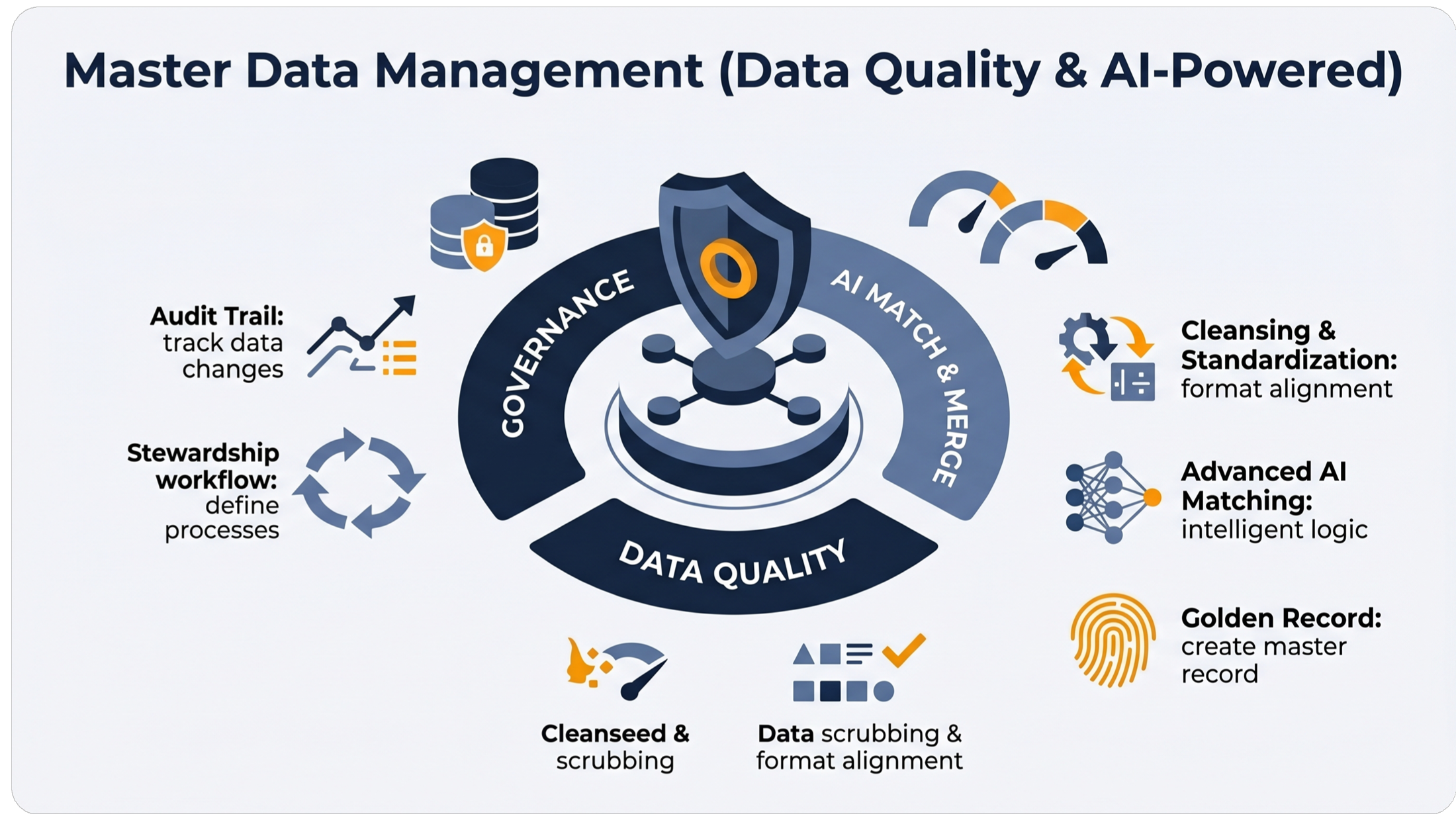 Figure 3: Governance, data quality, and AI-driven match and merge as the control plane
In this target-state architecture, Snowflake serves as the central platform for data governance and reconciliation. The platform performs continuous data quality monitoring, generating actionable dashboards for data stewards. If a mapping issue drops a critical product attribute such as a missing sterilization protocol for a single-use implant, Snowflake’s data quality alert framework flags the anomaly during the reconciliation process, ensuring the gold layer remains untainted and downstream applications receive complete, accurate payloads.
While material master challenges dominate the manufacturing side, customer and vendor data present their own distinct hurdles. Following a large-scale ERP consolidation, organizations frequently experience a surge in duplicate records across these domains.
Traditional deterministic matching rules simply cannot reconcile slight variations such as fragmented hospital network names, mismatched supplier identifiers, or inconsistent UDI references spanning the material and finance domains.
This is where AI-based duplicate resolution becomes critical. Machine learning-driven match and merge rules — implemented using Snowflake Cortex AI and dbt-powered transformation pipelines — move organizations beyond rigid exact-match criteria by evaluating phonetic similarities, historical name variations, and contextual clues such as shared billing addresses or linked procurement contracts. Applied across all four domains, this pattern ensures hospital networks, raw material suppliers, and corresponding cost structures are deduplicated and cross-linked in the Gold layer — enabling contract compliance, accurate sales crediting, and end-to-end implant traceability down to the patient level.
Implementation guidelines
Executing this modernization strategy requires meticulous planning:
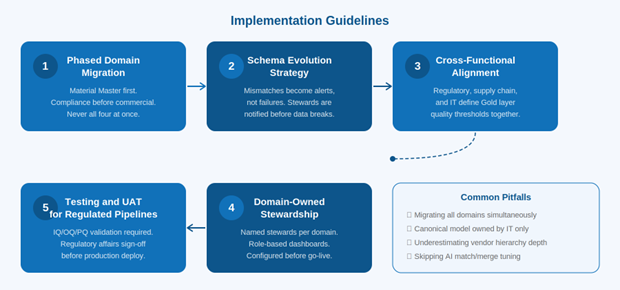
- Phased domain migration: Migrate the material master first, given its complexity with UDI and FDA attributes, before expanding to customer, vendor, and finance domains. This sequencing ensures the most compliance-sensitive data is mastered and verified before commercial and financial domains are layered in.
- Schema evolution strategy: Configure integration pipelines to alert data stewards of structural changes rather than failing the process, turning schema mismatches from a critical failure into a managed workflow.
- Cross-functional alignment: Regulatory, supply chain, and IT teams must collaborate to define the data quality thresholds for the gold layer. A product record should only be distributed to the downstream applications when all regulatory compliance fields are complete and verified.
- Domain owned Gold data products with governed stewardship: Each MDM domain team: Material, Customer, Vendor, Finance will own their Gold data product, defining quality thresholds and managing stewardship workflows via Snowflake’s Horizon governance framework and role-based access controls. Named data stewards per domain, with clear escalation paths for quarantined records, must be in place before go-live. Unowned data quality exceptions are the most common cause of Gold layer degradation post-launch. Centralized governance enforces the compliance guardrails; domain teams own the records.
- Testing and UAT for Regulated Pipelines: All bronze-to-gold pipelines in a regulated environment require documented validation including IQ/OQ/PQ protocols where applicable. Build UAT scripts that explicitly test UDI passthrough accuracy, FDA status field completeness, and duplicate resolution outcomes. Engage regulatory affairs in sign-off before production deployment.
Common Pitfalls to Avoid
- Attempting to migrate all four domains simultaneously leads to scope creep and deferred go-live
- Treating the canonical model as an IT artifact, it must be owned and approved by business and regulatory stakeholders
- Underestimating vendor master complexity - supplier hierarchies in implantable device supply chains are often many levels deep
- Skipping AI match/merge tuning before production use
Make your data AI-ready: From Gold layer to Intelligence layer
A well-governed gold layer is the prerequisite for AI but not sufficient on its own. In a regulated device environment, where a flawed AI recommendation could influence implant selection, supplier qualification, or recall scoping, the stakes of poor AI data readiness are critical.
Four steps extend the Medallion Architecture into an AI-ready Intelligence layer.
Completeness first: Every Material, Customer, Vendor, and Finance master record must pass Gold layer quality gates before entering any AI pipeline. Organizations that feed AI models from Silver-layer data experience a 3x higher model retraining rate due to data drift. UDI, ROBAR flags, NPI numbers, and vendor qualification status must all be fully validated. AI models trained on incomplete records produce confident, wrong answers.
Knowledge graph as the AI context layer: A flat Gold layer record is still a row of attributes. AI models derive reasoning power from relationships between entities, not attributes in isolation. Snowflake’s Cortex AI and graph-capable data products ingest mastered Gold layer entities and map them as connected nodes such as a hip implant SKU linked to its UDI, FDA GUDID entry, sterilization protocol, and raw material supplier; a surgeon node connected to their IDN affiliation, GPO contract, and preferred implant history. These traversal paths answer questions flat master data cannot: which implants from at-risk suppliers are currently implanted in active patients, or which surgeons in a given IDN are using off-contract devices.
Lineage for regulatory explainability: FDA AI/ML SaMD guidance and the EU AI Act both require that AI inferences be traceable to their source data. Snowflake’s native data lineage and Access History capabilities ensure every Gold layer record carries its full transformation history, so when an AI model produces a demand forecast or supplier risk score, the organization can demonstrate exactly which mastered records drove that output during an audit.
Feature engineering on Snowflake: Gold layer records are transformed into model-ready features: rolling sales velocity by SKU and IDN for demand forecasting, on-time delivery rates and geographic concentration indices for supplier risk scoring, and chargeback exception rates for contract compliance monitoring. These features are stored in a governed feature store with versioning and lineage linkage back to their gold layer origin.
Looking Ahead: The Next Frontier in Medical Device MDM
The Medallion Architecture on Snowflake represents a strong modern foundation for regulated medical-device data platforms. However, Master Data Management (MDM) is just one component within a broader data modernization strategy that also includes governance, interoperability, real-time integration, analytics, and AI enablement.
Three developments are likely to shape the next generation of data modernization in regulated medical-device supply chains:
AI-assisted data stewardship and governance
Generative AI and large language models are beginning to support data stewardship activities by helping identify data anomalies, suggesting attribute mappings, improving metadata documentation, and accelerating canonical model design. Platforms such as Snowflake are introducing AI-enabled capabilities that can enhance governance, quality management, and operational intelligence across modern data ecosystems.
Real-time operational data integration
As robotic-assisted surgery, connected devices, and just-in-time implant logistics become more common, organizations require low-latency synchronization across operational and analytical systems. Modern architectures increasingly combine streaming pipelines, event-driven integration, dynamic tables, and automated orchestration to support near-real-time visibility across ERP, MES, supply-chain, and clinical systems extending beyond traditional MDM use cases.
End-to-end digital traceability
Regulators in the EU and the US are moving toward more comprehensive digital traceability across the medical-device lifecycle, including supplier provenance, manufacturing genealogy, UDI compliance, distribution, and patient linkage. Organizations investing in interoperable data platforms, governance frameworks, and trusted data products today are building the foundation needed to support future regulatory, operational, and analytical requirements.
FAQs
Schema mismatches typically occur when upstream source systems (like SAP MDG) add new data types, structural hierarchies, or regulatory attributes that the downstream integration hub was not coded to accept, resulting in mapping failures.
The medallion architecture separates data processing into stages (Bronze, Silver, Gold). This allows raw data to be safely ingested, thoroughly cleansed and validated in the intermediate stage, and only exposed to downstream systems once it reaches ‘Gold’ status.
Traditional rule-based matching often fails when merging disparate data sources, leading to duplicate surges. AI-based resolution uses probabilistic matching to understand context, typos, and variations, accurately linking records across customer, vendor, and other domains.
Beyond standard dimensions and SKUs, implantable devices require tracking of sterilization methods, single/multi-use status, ROBAR/UDI labels, country-specific selling restrictions, and multi-step FDA approvals tied to expiration dates.
The Unique Device Identification (UDI) system, mandated by the FDA, requires that medical devices carry a unique identifier that links the physical device to its master record in the FDA Global Unique Device Identification Database (GUDID). UDI consists of a Device Identifier (DI), which is fixed and describes the device version, and a Production Identifier (PI), which carries lot number, manufacturing date, and expiry. UDI is the regulatory anchor of the Material Master, every downstream transaction, from hospital procurement to patient implantation, must be traceable back to a valid UDI record in the gold layer.
AI readiness requires four steps beyond standard MDM governance: enforcing Gold layer completeness so no incomplete record enters an AI pipeline; semantically enriching records by linking UDIs to FDA GUDID attributes and SKUs to clinical indication categories; instrumenting full data lineage to satisfy FDA AI/ML and EU AI Act explainability requirements; and engineering model-ready features — demand velocity, supplier risk indices, contract compliance ratios — stored in a versioned, governed feature store linked back to Gold layer origins.