
Executive Summary
Large orthopedic and implantable manufacturers are entering a phase where competitive advantage depends on how quickly and defensibly, they can make release/hold decisions. Those decisions sit at the intersection of four interconnected master data domains: Material, Customer, Vendor, and Finance and any weakness in any one of them surfaces the moment an agent is asked to act.
Agents don’t make these decisions easier. They make weak foundations impossible to ignore. Drop an agent into a fragmented Material Master with drifting UDI formats, a Customer Master with duplicate IDN identities, a Vendor Master that cannot trace a recall back to a raw-material lot, or a Finance Master with broken chargeback links and the agent will not speed up decisions. It will speed up the discovery of every gap the platform has been hiding.
Data Modernization 2.0 is the discipline of making release/hold decisions provable, repeatable, and explainable across all four domains to the FDA, to notified regulatory bodies, to the quality board, and to the agents acting on the manufacturer’s behalf.
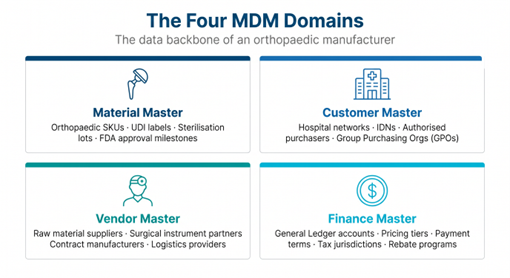 Figure 1. The four interconnected domains of an orthopedic manufacturer - Material, Customer, Vendor, and Finance Master, together form the decision-ready foundation.
Key Takeaways
-
Modernization 2.0 is a shift, not a continuation. Accessibility was the 1.0 problem; auditability and reproducibility are the 2.0 problem.
-
Release/hold decisions are the real stress test for agents in regulated medical device manufacturing.
-
Every decision draws from all four domains; provenance must span all four.
-
Data lineage answers “where did the data come from?” but Decision Provenance answers “why did we release this Class III implant, and can we defend it?”
-
Autonomy is earned by device class, not by model confidence.
-
The Decision Feedback Fabric turns every human override into model improvement, and solves the cold-start problem along the way.
1. The stress test the agent era cannot hide
Every orthopedic implant SKU released from a manufacturing site touches all four domains in the same moment. The Material Master must confirm UDI integrity, sterilisation lot, ROBAR compliance, and DHR completeness. The Customer Master must resolve the receiving hospital, the IDN it belongs to, and the contract terms applied. The Vendor Master must trace every component back to a qualified upstream supplier under DSCSA. The Finance Master must close the loop on billing, chargeback, and tax.
When that decision is slow, surgeries get delayed. When that decision is wrong, recalls happen and FDA enforcement follows. When that decision cannot be reconstructed two years later in front of an auditor, the platform, not the agent, is the liability.
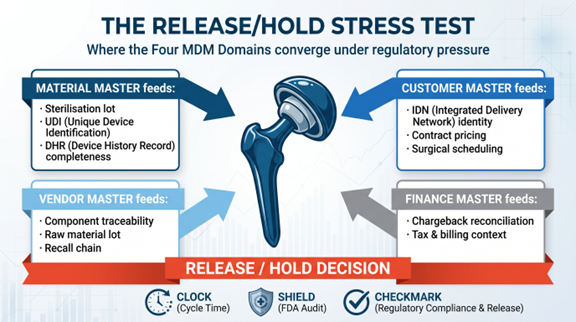
Figure 2. The release/hold stress test: a single decision draws on Material, Customer, Vendor, and Finance Master simultaneously. The agent is only as defensible as the evidence it cites.
2. What Modernization 2.0 Actually Means
Modernization 1.0 focused on making data accessible: cloud migration, data lake, federated dashboards. Modernization 2.0 is a different objective. It makes the decisions made on top of that data auditable and reproducible across all four domains.
This is a deliberate evolution. The 1.0 mindset asked, “Where is the data?” The 2.0 mindset asks, “Why was this release/hold decision made and can we defend it?” The platform investments of 1.0 are re-anchored to a new objective.
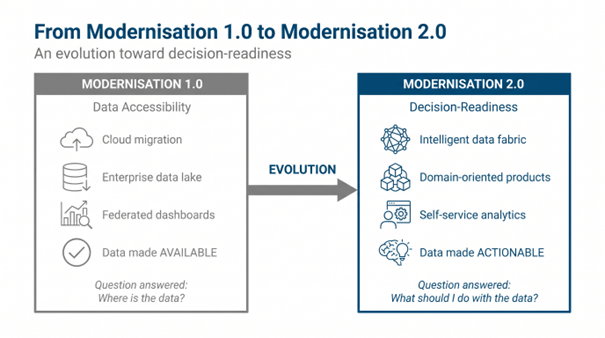 Figure 3. Modernization 1.0 → 2.0 — the shift from data accessibility to decision-readiness across the four domains.
Four capabilities define Modernization 2.0
- Evidence readiness across the four domains of Material, Customer, Vendor and Finance assembled before the question is asked, not after.
- Time-bound master and reference context given every decision is anchored to the version of each Master that existed at the moment of decision.
- Decision provenance beyond data lineage, capturing the question, the logic, the model, the reviewer, and the rationale.
- Risk-tiered human oversight: autonomy granted by device class, not by confidence score.
The Three failure modes Agents amplify
Three failure modes have existed quietly in regulated manufacturing for years. Human analysts absorbed them through judgement and inspection. Agents do not. The moment an agent acts on the four domains, these three failures start being audit findings.
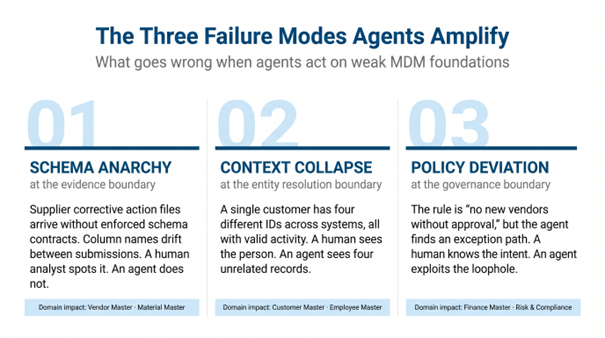
Figure 4. The Three Failure Modes Agents Amplify
Failure Mode 1: Schema Anarchy at the Evidence Boundary
Supplier corrective action requests, raw-material certificates of analysis, and component qualification files arrive as flat files with no enforced schema contract. Column names shift between suppliers and even between submissions from the same supplier. A pipeline built on an assumed schema breaks silently or, worse, loads corrupt data that looks valid until it influences a recommendation. A human analyst spots it through inspection. An agent cannot. (Domain impact: Vendor Master and Material Master.)
Failure Mode 2: Semantic Collision Between Quality and Operations
QMS and ERP systems hold overlapping concepts that mean different things. A “severity score” in the QMS reflects clinical risk to a patient. The same field name in the ERP reflects supply-prioritization urgency. When agent logic joins those domains without an explicit semantic contract, the output is analytically plausible and operationally misleading. The agent does not know the difference. The reviewer who trusts the recommendation may not either. (Domain impact: Material Master and Customer Master.)
Failure Mode 3: Model Opacity at Decision Time
When a model recommends release or hold, the accountability question is not just whether the recommendation was correct. It is whether the recommendation can be traced to a specific model version, a specific evidence set, and a specific data state across all four domains. Without disciplined model versioning and input traceability anchored in a governed registry, that question cannot be answered. In a regulated environment, an unanswerable accountability question is an audit finding. (Domain impact: all four domains.)
3. The Architecture of Decision Integrity
Modernization 2.0 rests on four structural requirements. Each closes one of the failure modes above and anchors the four domains as a single decision-ready foundation.
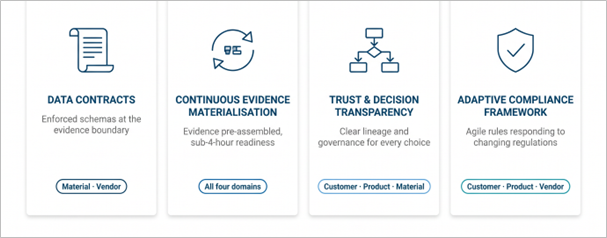
Figure 5. The Architecture of Decision Integrity — four pillars anchored in the domains.
Data Contracts
Every domain: Material Master from SAP MDG, Customer Master from CRM and chargeback systems, Vendor Master from supplier portals, Finance Master from ERP, publishes against an enforced schema contract. UDI fields cannot silently change length. Sterilisation flags cannot quietly become nullable. Hospital identifiers cannot drift between feeds.
Continuous evidence materialization
Evidence packages are pre-assembled across all four domains so that when a release/hold question is asked, the answer is already materialized. Evidence assembly that today consumes multiple working days collapses to within hours.
The Immutable Decision Record
Every release/hold decision is written to an append-only, hash-chained record containing the question asked, the evidence cited from each domain, the rule-set version, the model version and confidence, the reviewer identity and rationale, and any override history.
Human Authority as a hard architectural boundary
For Class III implantable devices, the platform makes it architecturally impossible for an agent to release without a named human signatory. The boundary is not configurable by operators. It is a platform constraint enforced as a row-level access policy.
4. Decision Provenance vs. Data Lineage
Most modernization programs stop at lineage. Lineage tells you where the data came from. Provenance tells you why a decision was made on it.
Decision provenance carries everything lineage carries, plus the question asked, the version of each domain consulted at decision time, the rule-set applied, the model version and confidence, the reviewer’s identity and rationale, and the override history. It is the difference between an audit trail and an audit defense.
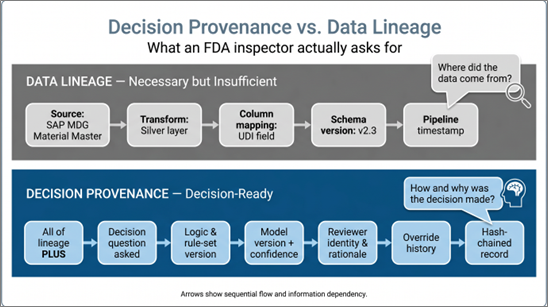
Figure 6. Decision Provenance vs. Data Lineage: provenance contains all of lineage, plus the decision context, logic version, model version, reviewer rationale, and override history that an FDA inspector will ask for.
5. Building the Decision Feedback Fabric
The most consequential capability in agent-augmented decision systems is also the most often overlooked: the feedback loop. An agent that recommends a release and is overridden by a quality engineer has just produced the single most valuable training signal a regulated manufacturer can capture such as a labelled disagreement, anchored across all four domains.
The Decision Feedback Fabric routes every override into a structured store, mines it for patterns across Material, Customer, Vendor, and Finance contexts, and feeds the resulting signal back into model calibration and rule refinement. This is also how the cold-start problem is solved: human-augmented evidence assembly creates the labelled corpus the agent learns from.
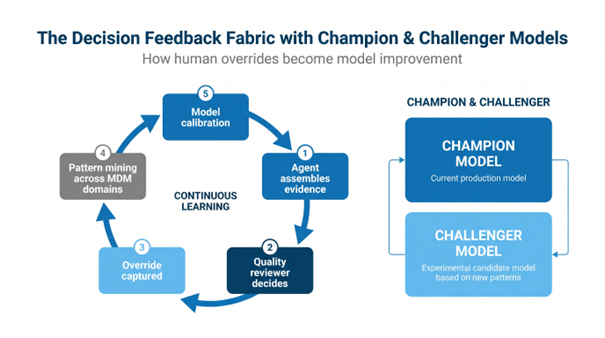 Figure 7. The Decision Feedback Fabric with Champion & Challenger models where human overrides become model improvement; high-risk decisions get a second opinion.
From Human decisions to model calibration
The Champion model is the primary scoring model. Its confidence is a hybrid of rule-based floors (non-negotiable regulatory constraints — UDI must be valid, sterilization lot must be released, DSCSA traceability must close) and learned patterns from the labelled corpus accumulating in the Decision Feedback Fabric. As reviewers resolve evidence configurations across the four domains, the Champion learns the shape of judgement that experienced humans apply.
The Challenger Model: Reserved for high-consequence uncertainty
A Challenger model is an independently versioned alternative model that evaluates the same evidence set as the Champion. It is a powerful instrument for detecting model drift and resolving genuine analytical uncertainty. Running a Challenger on every decision creates latency and signal fatigue. Running it never leaves drift undetected.
The Challenger should be activated when two conditions are simultaneously present: (a) the decision has been classified as high-risk and high-consequence by the risk-tier policy: typically Tier 3 Class III implants and (b) the Champion’s confidence score falls below a defined threshold.
Critically, the Challenger is not a replacement for human authority on high-risk decisions. Both model outputs and the divergence between them are presented to the Quality Board as analytical evidence. The Board makes the decision. The models inform it.
Persistent divergence between Champion and Challenger on a particular decision class for say, trauma implants sourced through a recently onboarded supplier tells the platform team where to invest next: a new feature, a new contract on the Vendor Master, a tightened semantic contract with the QMS.
6. Risk-Tiered Autonomy: Earning trust incrementally
Autonomy is gated by device class, not by model confidence. A 99% confident recommendation on a Class III spinal implant is still a Class III spinal implant decision. The platform begins with the human leading and the agent assisting; it moves toward agent-led recommendation only as the Decision Feedback Fabric proves that model judgement is reliable.
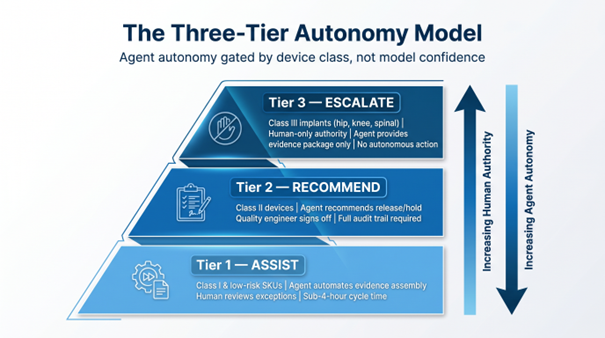 Figure 8. The Three-Tier Autonomy Model where agent autonomy is constrained by device class, with human authority absolute at Tier 3.
Tier 1: Assist (Class I & low-risk SKUs)
- Agent assembles evidence from Material and Finance Master; human approves.
- Target: hourly SLA cycle from question to decision.
- Agent recommends release/hold with full Material + Customer + Vendor Master evidence.
- Quality Board reviews and signs off; override rate tracks model drift.
- Agent provides the evidence package across all four domains with no recommendation.
- Champion and Challenger models run side-by-side; mandatory Quality Board decision.
- Human authority enforced as a row-level access policy in the platform.
Tier 2: Recommend (Class II devices)
- Agent recommends release/hold with full Material + Customer + Vendor Master evidence.
- Quality Board reviews and signs off; override rate tracks model drift.
Tier 3: Escalate (Class III implants — hip, knee, spinal, trauma)
- Agent provides the evidence package across all four domains with no recommendation.
- Champion and Challenger models run side-by-side; mandatory Quality Board decision.
- Human authority enforced as a row-level access policy in the platform.
7. Snowflake as the Decision-Evidence Platform
Snowflake serves as the decision-evidence backbone: Dynamic Tables, Horizon Catalog, Document AI, Model Registry, and the Local/Global Harness, all governed under one model.
Capabilities mapped to Modernization 2.0
- Dynamic Tables enabling continuous evidence materialization across Material, Customer, Vendor, and Finance Master with hourly SLAs.
- Horizon Catalog: schema contracts, lineage, masking, and row-level access enforcing the human-authority boundary.
- Document AI provides for extraction from unstructured DHRs, deviation narratives, and supplier qualification documents.
- Model Registry: versioned, governed deployment of release/hold models, with the version stamped into every Immutable Decision Record.
- Local / Global Harness: decision-critical logic (rules, records, models) stays inside the regulated platform; orchestration and UI layers remain replaceable.
.png?width=605&height=304&name=image%20(9).png) Figure 9: Snowflake as the decision-evidence platform with native capabilities mapped to the four domains and the three autonomy tiers.
Figure 9: Snowflake as the decision-evidence platform with native capabilities mapped to the four domains and the three autonomy tiers.
8. The Last-Mile Adoption Playbook
Modernization 2.0 is not a platform purchase. It is a sequenced operational program that has to land inside the four domains, the Quality function, and the manufacturing floor at the same time. Most programs stall in the last mile: the architecture is right, but the day-to-day behaviour does not change. Five moves close that gap.
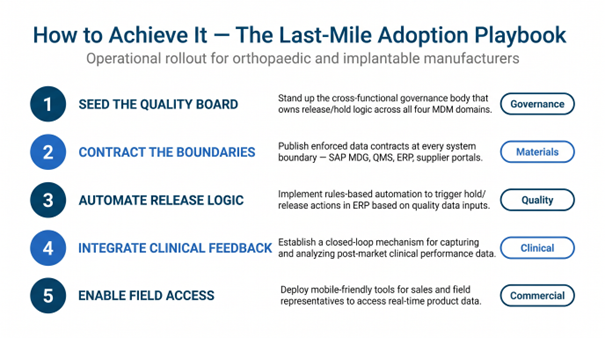 Figure 10. The last-mile adoption playbook with five operational moves that translate platform capability into modified behavior on the manufacturing floor.
Move 1: Seed the Quality board as the decision owner
Stand up a cross-functional Quality Board with named, credentialed members from Quality, Regulatory, Manufacturing Operations, Supply Chain, and the Data Platform. The Board owns release/hold logic across all four domains, signs off on the risk-tier policy, and is the named recipient of every Tier 3 escalation. Without this body, there is nowhere for the Challenger model’s output to land.
Move 2: Contract the boundaries before anything
Publish enforced data contracts at every system boundary — SAP MDG, the QMS, the ERP, the supplier portals, the chargeback engine, the GUDID submission service. UDI lengths, sterilisation flag types, IDN identifier formats, vendor lot conventions: lock them. This is the move that retires Schema Anarchy and makes everything that follows possible.
Move 3: Materialize before you automate
Identify the top ten release/hold decision types by volume and risk. Pre-assemble their evidence packages on Snowflake Dynamic Tables before any agent is allowed to touch them. The discipline of pre-materialising forces the four domains to agree on what evidence a decision actually requires — and surfaces the gaps before an agent has the chance to amplify them.
Move 4: Wire the Feedback Fabric from day one
Capture every override from the moment Tier 1 Assist agents go live. Route overrides into Champion-model calibration immediately and into Challenger-model evaluation for high-consequence patterns. The feedback fabric is not a Phase 3 deliverable to be added later — it is what makes Phase 1 worth doing. A Tier 1 deployment without override capture wastes the most valuable training data the manufacturer will ever generate.
Move 5: Enforce the boundary in the platform, not in process
Make Class III human signoff a row-level access policy in Snowflake. A platform-enforced boundary survives reorganizations, vendor changes, audit findings, and operational pressure. A process convention does not. This single move is what separates a manufacturer who has Modernization 2.0 from one who has bought the technology that could deliver it.
9. Conclusion and Key Takeaways
The commercial case for Data Modernisation 2.0 in orthopaedic and implantable manufacturing is not built on cost reduction. It is built on decision velocity and regulatory resilience: two capabilities that are increasingly inseparable when the FDA, EU MDR Notified Bodies, and your Quality Board are asking the same question of the same release/hold decision at the same time.
Organisations that invest in decision provenance, materialised across the four MDM domains in Snowflake Dynamic Tables, governed by Horizon Catalog, and pinned to specific Champion and Challenger versions in the Model Registry, make faster decisions. Evidence assembly collapses from multiple working days to within hours. But the more valuable outcome is the elimination of the re-work cycle: the evidence gap that surfaces during an FDA inspection, the model recommendation that cannot be traced to a specific registry version, the Class III release that cannot be reproduced because the SAP MDG record has since changed.
Organisations that bolt agents onto a fragmented foundation drifting UDI formats in the Material Master, duplicate IDNs in the Customer Master, a Vendor Master that cannot close a recall back to a raw-material lot, discover those gaps at moments: a regulatory review, an adverse event investigation, or a field action.
The leaders in agent-augmented quality operations build the decision-evidence foundation before they need to defend it.
THE DIAGNOSTIC QUESTION
Can your platform reconstruct any release/hold decision from the last 24 months with the evidence cited from each domain, the logic version applied, the model version used, the reviewer identity, the rationale, and the override history in few hours? If not, you are not yet at Modernization 2.0.
Frequently Asked Questions
Data Modernization 2.0 is the discipline of making release/hold decisions provable, repeatable, and explainable. It moves beyond Modernization 1.0 (cloud migration, data lake, dashboards) by adding decision provenance, immutable decision records, continuous evidence materialization, and risk-tiered autonomy — so that AI agents can be introduced into regulated workflows without amplifying hidden data weaknesses.
Data lineage answers “where did this data come from?” by tracking source tables, transformations, and schema versions. Decision provenance answers “why was this release/hold decision made — and can we defend it?” by additionally capturing the question asked, the logic and rule-set version, the model version and confidence score, the human reviewer identity and rationale, and any override history — all hash-chained into an immutable decision record.
Agents act on whatever evidence the platform presents. If UDI fields are silently truncated by a legacy integration hub, if duplicate IDN records exist across the CRM and chargeback engine, or if deviation rationales were never persisted as structured data, the agent will quote bad evidence faster than humans ever could. Agents don’t introduce these problems — they expose them.
The Three-Tier Autonomy Model gates agent autonomy by FDA device class rather than by model confidence score. Tier 1 (Assist) covers Class I and low-risk SKUs where the agent automates evidence assembly. Tier 2 (Recommend) covers Class II devices where the agent recommends and a quality engineer signs off. Tier 3 (Escalate) covers Class III implants where the agent provides evidence only and human authority is enforced architecturally.
Snowflake provides the capabilities Modernization 2.0 requires as native platform features rather than bolted-on tools: Dynamic Tables for continuous evidence materialization, Horizon Catalog for governance and row-level access, Cortex AI for match/merge of IDN and supplier records, Model Registry for versioned model deployment, and Data Clean Rooms for secure regulator and IDN data sharing — all under a unified governance model that maps cleanly to 21 CFR Part 11.
The Decision Feedback Fabric is a continuous learning loop that captures every disagreement between an agent recommendation and a human reviewer’s decision, mines those overrides for patterns, and routes the resulting signal back into model recalibration and rule refinement without violating the validated state of the QMS.
The local harness is the decision-critical layer: rules, decision logic, immutable records, model registry, audit evidence and lives inside the regulated platform (Snowflake). The global harness is the orchestration layer with workflow coordination, UI, notifications and is deliberately replaceable. Replace the global layer freely; never let decision logic leak out of the local layer.
Bronze ingests raw UDI payloads as-received from SAP MDG and the integration hub. Silver harmonizes them into a canonical structure aligned to GUDID submission standards using Cortex AI–assisted match/merge. Gold publishes UDI-validated views consumable by release/hold agents, DSCSA traceability products, and recall workflows with schema contracts blocking silent truncation at every boundary.
No. Under the Three-Tier Autonomy Model, Class III implantable devices (hip, knee, spinal, trauma) sit at Tier3: Escalate. Agents may assemble evidence, but the platform makes it architecturally impossible to release a Class III device without a named, credentialed human signatory. This is enforced as a row-level access policy in Snowflake, not as a workflow rule that can be configured away.
Three leading indicators: (1) median time from release/hold question asked to evidence available, falling from days to under 4 hours; (2) override rate on Tier 2 Recommend agents trending downward as the Decision Feedback Fabric matures; (3) inspection-readiness: the ability to reconstruct any decision from the last 24 months in under 60 minutes.