



In the era of always-on services and instant customer expectations, the speed at which organizations move data can significantly impact both user experience and operational efficiency. Whether it's syncing transaction records, processing large-scale audits, or updating critical customer information, the choice between real-time streaming and batch processing has become a strategic one—especially in data-intensive sectors like finance, retail, logistics, and automotive.
A modern real-time data warehouse strategy should also consider latency, operational cost, and downstream consumer expectations before choosing a processing model. That makes the decision more about business fit than technical preference alone.
While batch processing has long been the workhorse of traditional data warehousing—ideal for handling large volumes of data in scheduled, controlled environments—it can fall short in dynamic environments where speed and responsiveness are non-negotiable. On the other hand, real-time streaming offers unparalleled immediacy but comes with higher complexity, costs, and demands on infrastructure.
In many enterprise environments, batch data integration still plays an essential role for reconciliation, reporting, and lower-priority workloads. The key is knowing which data flows can tolerate delay and which cannot.
Modern enterprises no longer see this as an either-or decision. Instead, they are moving toward hybrid data architectures, blending the strengths of both approaches to meet diverse business needs, technical constraints, and partner expectations. Let's examine how one organization in the automotive finance and insurance sector adopted this approach to modernizing its external data exchange systems.
That shift is often described through patterns such as Lambda vs Kappa architecture, where organizations either combine batch and streaming layers or converge on a simpler event-driven design. Choosing between them depends on governance, complexity, and speed requirements.
Case study: How a leading automotive F&I provider optimized external data exchange
Industry: Automotive Financial Services
Client: A prominent F&I (Finance & Insurance) provider collaborating with dealerships and OEMs
Challenge: Build a modern, scalable external data exchange framework for contracts, claims, and cancellations
Solution: A hybrid data architecture combining real-time streaming and batch processing, built on Azure-native services
This type of design is especially useful when organizations need real time vs batch integration across partners that do not all move at the same speed or maturity level. It allows critical events to move instantly while less urgent workloads stay in controlled batches.
Background & business context
In today's connected automotive ecosystem, data exchange is mission-critical. Our client, a leading F&I provider in North America, faced a pressing challenge: modernize their data infrastructure to support seamless information flow between their internal systems and external stakeholders—including dealerships, OEMs, and third-party warranty vendors.
Their legacy architecture was heavily reliant on traditional batch ETL pipelines. While functional, this setup suffered from long processing times, limited scalability, and high maintenance overhead. As data volumes and integration points grew, so did the urgency to evolve. The critical question became:
"Should we stick with batch and optimize or transition to real-time streaming for faster, smarter operations?"
A key part of the modernization effort was introducing Change Data Capture (CDC) so only new or changed records moved downstream instead of full reloads. This reduced processing overhead and improved responsiveness without forcing every workflow into full streaming.
Real-time vs. batch processing: Defining use cases with intent
Instead of choosing one over the other, the team took a use-case-driven approach to define where each processing method made sense:
Batch Processing was retained where:
- High volumes of data could be processed during non-peak hours (e.g., nightly summaries and reports)
- Compliance and reconciliation took precedence, requiring complete and accurate datasets
- Partner systems still operated using legacy methods like FTP/SFTP transfers
- Operational cost-efficiency could be achieved through scheduled, low-impact jobs
In some cases, micro-batch as a middle option can be the best fit because it gives teams lower latency without the operational complexity of full streaming. This is often a practical compromise for organizations moving toward real-time maturity.
Real-time streaming was deployed where:
- Immediate feedback was critical (e.g., during contract submission, approval, or cancellations)
- Customer-facing applications needed responsive data for a better experience
- SLAs demanded low-latency interactions with dealerships and end customers
- Microservices architecture powered asynchronous, event-driven workflows
Streaming pipelines also need clarity on delivery guarantees, because exactly-once vs at-least-once semantics can affect reconciliation, deduplication, and downstream trust. That choice should be made explicitly rather than assumed.
The hybrid solution architecture: Powered by Azure
The client adopted a hybrid data movement strategy using Microsoft Azure’s native capabilities:
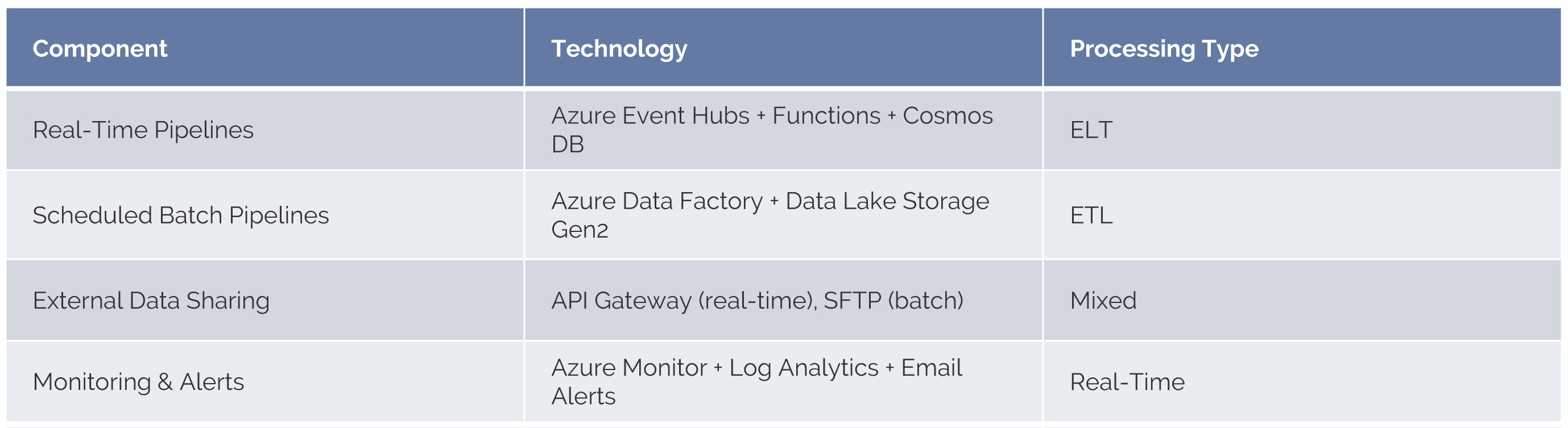
When comparing streaming framework comparison: Kafka, Flink, Spark Streaming, the right choice usually depends on whether the priority is event ingestion, stateful processing, or broader analytics integration. Each framework brings different strengths to hybrid data architectures.
This flexible approach allowed the client to dynamically align data movement with business priorities—whether speed, accuracy, or cost-efficiency.
Key takeaways
- Event-driven = better UX: Real-time contract updates and cancellation feedback created smoother dealer interactions.
- Monitoring is a must: Real-time streaming requires real-time observability. Alerts prevent silent failures.
- Hybrid wins: Not all data needs to be streamed. Critical paths benefit from real-time; batch excels in back-office support and audit trails.
- Governance still matters: Regardless of whether it's ETL or ELT, tracking data lineage and ensuring reconciliation logs remain vital for compliance.
For teams evaluating real-time data observability vs batch processing for AI pipelines, the most important issue is whether the pipeline can surface failures and quality issues quickly enough to protect downstream decisions. Observability is especially critical when streaming is part of operational workflows.
What's next?
As cloud-native tools like Microsoft Fabric and Databricks Delta Live Tables evolve, the boundary between batch and real-time is becoming increasingly fluid. These platforms are beginning to support unified architectures where data pipelines can auto-adapt based on SLAs, data volume, or even event triggers.
As organizations mature, they increasingly blend CDC, streaming, and micro-batch patterns to balance performance and cost. This creates a more flexible architecture that can evolve with changing business SLAs.
However, the underlying principle remains unchanged: Purpose-built architecture. The correct data processing strategy should always align with the following:
- Business SLAs
- Data sensitivity and timeliness
- Partner integration maturity
- Compliance requirements
Conclusion
There's no "one-size-fits-all" data strategy when it comes to external data exchange. The real opportunity lies in building a responsive, scalable, and intelligent data infrastructure that understands when to stream data and when to schedule it. By embracing a hybrid model, our clients enhanced real-time responsiveness, ensured data integrity, reduced operational friction, and prepared themselves for a more agile, data-driven future in the automotive finance industry.
The best real-time batch processing strategy is the one that matches the business need, latency SLA, and cost-latency trade-off for each data flow. In practice, the strongest data strategies often combine all three modes: batch, streaming, and micro-batch.
Ready to transform your data exchange strategy?
Let's talk about what a real-time, batch, or hybrid architecture can do for your business.
