
The Bold Claim
The opening keynote at Data + AI Summit 2026 made one argument that resonated more strongly than any product announcement that followed. Ali Ghodsi told an audience of more than 30,000 data and AI practitioners that AI does not have an intelligence problem; it has a context problem. Reasoning benchmarks have improved faster than expected. Foundation models can now solve mathematics Olympiad problems, write production-quality code, and reason through multi-step scenarios that were beyond the previous generation of systems.
Yet enterprise AI outcomes have not kept pace with that progress. CFOs still struggle to get a clear explanation for margin movement in the last quarter. Sales leaders still cannot reliably identify which accounts are most likely to expand. Clinicians can ask the same question to three assistants and receive three different answers.
The gap between what foundation models can do in isolation and what they deliver inside an enterprise is not a model gap; it is a context gap. Organisations that keep investing mainly in model access, additional subscriptions, and prompt engineering will continue to run pilots that impress in demos but disappoint in production. Those that treat context as infrastructure will move ahead. This is the argument this paper explores for leaders shaping the next twelve to eighteen months of AI investment on the Databricks platform.
What Context Really Means
Context is an overused term that often lacks precision. Vendors claim to provide it, architecture diagrams reference it, and yet many conversations still begin without a clear definition. This ambiguity is costly for CIOs deciding where to invest. The appropriate way to define context in an enterprise is through three layers, each with distinct artefacts, owners, and platform requirements.
Semantic Context
Semantic context is the shared meaning behind the terms, metrices, and entities the business uses to describe itself. It defines an “active customer,” the logic behind “adjusted margin,” the rules for when a case is closed or resolved, and the relationships that connect a policyholder, claim, and payment. In most organisations, this meaning resides with a small group of analysts, scattered dashboard queries, and tribal knowledge that never reaches the catalog. As a result, two teams can ask the same question, receive different answers, and still lack a governed definition to explain the answer.
For an AI agent to be useful, semantic context must move from tribal knowledge into a governed, queryable form. Databricks put this at the centre of its Summit 2026 announcements with Genie Ontology, Unity Catalog Metrics, and the Business Glossary. With these capabilities, semantic definitions become first-class catalog objects that are versioned, permissioned, and available through a single canonical surface to every agent, dashboard, and downstream consumer.
Operational Context
Operational context is the live state of the business at the moment a decision is made. It includes current inventory, the transactional status of an in-flight order, open cases assigned to a care manager, and events received from upstream systems in the last few seconds. Analytical data alone is not enough for an agent that needs to act. An agent recommending the next best action for a customer must know what the customer did five minutes ago, not five hours ago.
Databricks addressed this at Summit 2026 with Lakebase, its platform-native transactional store, and LTAP, an architecture that enables transactional and analytical workloads to read and write the same open-format data. The goal is to close the gap between what the business is doing now and what the platform knows about it. For agents operating on live processes rather than historical reports, that gap must be measured in minutes, not hours.
Behavioural Context
Behavioural context is the pattern of how work actually moves through the organisation. It captures who approves what, which exceptions occur often, where escalations usually happen, and which decisions still need human judgement even when automation could proceed. This is the hardest layer to formalise and the one most organisations have addressed the least. It often lives in outdated process documents, tickets that record workarounds, and the collective memory of operations teams.
For agents to act responsibly in the enterprise, behavioural context must be built into the runtime rather than assumed. Databricks provides the primitives for this today through Mosaic AI Agent Framework, MLflow tracing, and Unity Catalog governance, with continued investment in making behavioural patterns easier to express natively. Organizations that build agent workflows on these primitives now will be well positioned as the platform surface matures further.
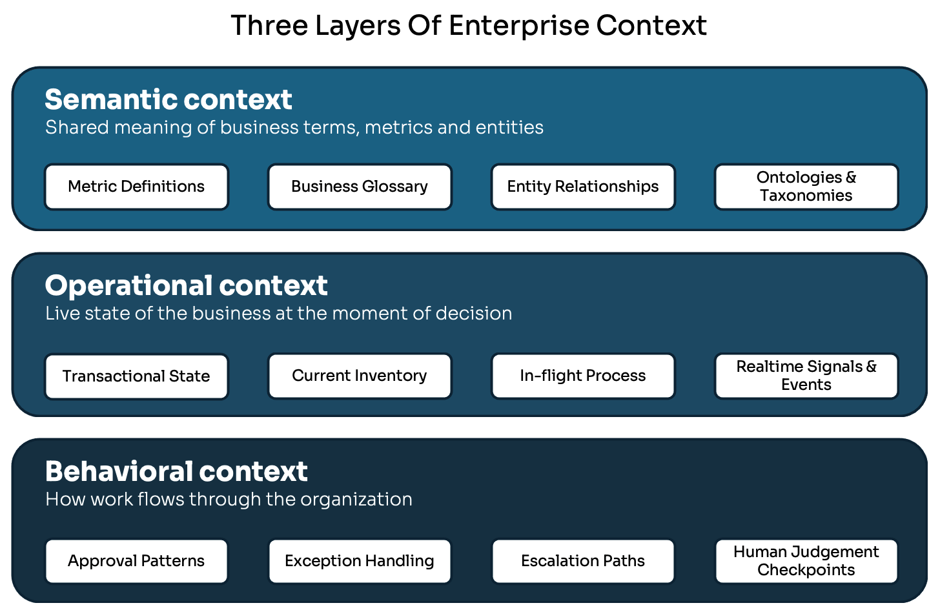
Figure 1. Three layers of enterprise context. Each layer requires a different platform capability to make it available to an agent.
The Four Cs
At Summit 2026, Databricks framed four challenges that stand between today’s enterprise AI efforts and the outcomes that leaders expect: context, cost, control, and choice. The Four Cs are valuable because they cut across product categories and focus the conversation on the operational realities that determine whether AI investment delivers measurable returns or not.
Context - the question of whether the meaning of the business is available to AI workloads in a governed and current form.
Cost - the question of whether AI spend is attributable, forecastable, and capped across models, teams, and use cases.
Control - the question of whether the autonomous actions of AI workloads are bounded by enterprise policy and auditable on demand.
Choice - the question of whether the organisation is architecturally free to change the models it uses without rewriting its agent estate.
The Gaps Exposed By Four Cs
Naming the Four Cs is straightforward, applying them to the current enterprise environment is the harder task. Each one reveals a specific gap between existing investments and what production-grade agent workloads require.
The Gap In Context
Context in the enterprise comes down to whether business meaning is treated as a shared asset or left as private knowledge. In most organisations, definitions such as “customer,” “revenue,” or “active user” sit in trusted queries and in the tacit expertise of the analysts who created them. As a result, each new AI initiative has to rebuild that meaning from the ground up, and different agents can return slightly different answers to the same question. The Four Cs frame identifies this as an infrastructure gap, not simply a data quality problem. The answer is not to clean the data harder, but to make the semantic layer a governed, first-class part of the platform.
The Gap In Cost
Cost in the enterprise comes down to whether AI spend is attributable and forecastable, or whether it has become a growing line item no one can explain. Most organisations cannot yet answer three basic questions about AI consumption.
- Which team consumed the most inference last month.
- Which use case had the highest cost per useful outcome.
- What spend will look like at ten times the current agent volume.
This framing shows that AI spend is being managed much like cloud spend was in 2015, before FinOps became a discipline. Controls have not kept pace with consumption, and that gap will surface in budget conversations over the next four quarters.
The Gap In Control
Control in the enterprise comes down to whether agent actions are bounded and auditable, or left to the discipline of individual developers. When an agent drafts a customer communication, writes to a database, or triggers a downstream workflow, the organisation must be able to answer three questions on demand: what the agent did, under whose authority, and against which data. Most organisations cannot answer these questions consistently today. This framing exposes the gap between what agents can do technically and what the enterprise can defend operationally, a gap that will not withstand serious regulatory or audit scrutiny.
The Gap In Choice
Choice in the enterprise comes down to whether the organisation can change its underlying models freely, or whether it has created lock-in through hard-coded prompts, provider-specific integrations, and evaluation harnesses tied to one vendor. This framing treats model diversity as a governance and portability issue, not a procurement decision. Organisations that miss this point often discover, eighteen months into a foundation model relationship, that switching costs exceed the original build. Choice is far easier to preserve in the architecture than to recover later.
Viewed together, the Four Cs point to one common issue. They are not four separate problems, but four symptoms of the same underlying condition: AI adoption has moved faster than the operational scaffolding needed to support it. Organisations that treat them as separate remediation efforts will create fragmented responses. Those that address them as one platform scaffolding challenge will build a more coherent enterprise posture.
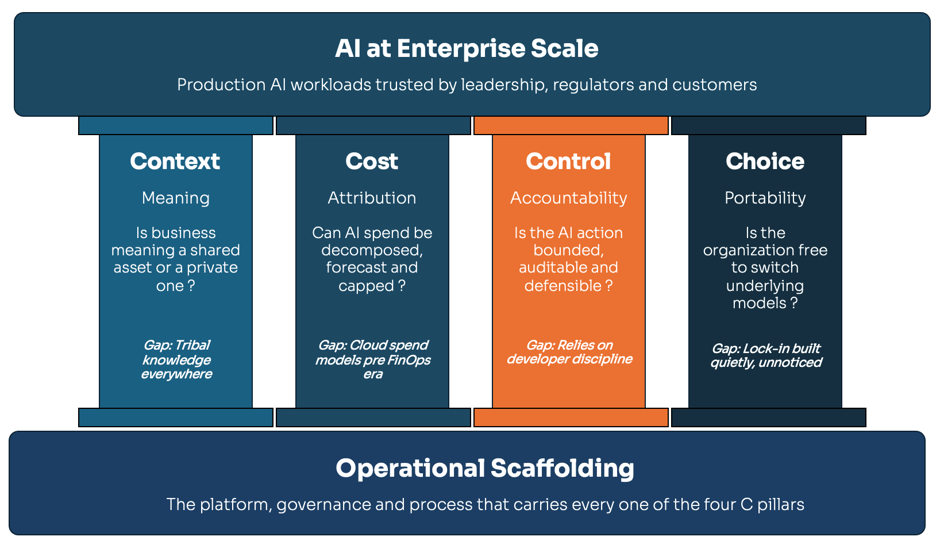
Figure 2. The four Cs are four pillars of the same operational foundation. Addressed together, they define the scaffolding that AI at enterprise scale requires.
The Investment Shift
For leaders planning AI investment on Databricks over the next 12 - 18 months, the Four Cs point to a practical budget shift. Three moves matter most, and they will separate organisations ready to run production agent workloads by the end of 2027 from those still remain in pilots.
Model Access To Context Infrastructure
The first shift moves budget away from subscriptions to more foundation models and toward the semantic and operational infrastructure that makes any model useful. Ontologies, business glossaries, governed metrics, entity relationships, and live operational state are the surfaces that determine whether an agent can answer a real business question. On the Databricks platform, this means investing in Unity Catalog Metrics, Genie Ontology, the Business Glossary, and the connection between analytical and transactional data that Lakebase and LTAP now support. This may be the least visible item in the AI budget, but it is the investment that determines whether AI remains a pilot or moves into production.
Point Solutions to Governed Runtime
The second shift moves fragmented, team-specific AI stacks into a single governed runtime. When each team builds its own agent framework, uses separate model endpoints, and maintains separate audit trails, the organisation cannot reliably answer what it is spending, what its agents are doing, or which data they are accessing. Unity AI Gateway, Mosaic AI Agent Framework, MLflow, and Lakehouse Monitoring provide the platform layer for governance across models and teams. The investment shift is from accepting fragmentation in the name of speed to making consolidation a prerequisite for enterprise scale.
Platform Modernisation to Agent Readiness
The third shift broadens the goal of modernisation. Many organisations still view migration from legacy EDW and ETL platforms as the destination, with the Lakehouse as the finish line. That view is now too narrow. The Lakehouse is the foundation, not the endpoint. An agent platform also needs transactional state alongside analytical state, low latency access to features and semantic definitions, and governed data access within the external tools where work happens. Lakebase, LTAP, Online Tables, and Delta Sharing are the capabilities that turn a modernised platform into an agent ready one. Organisations that complete migration without extending into these areas will be modernised, but not ready for enterprise AI workloads.
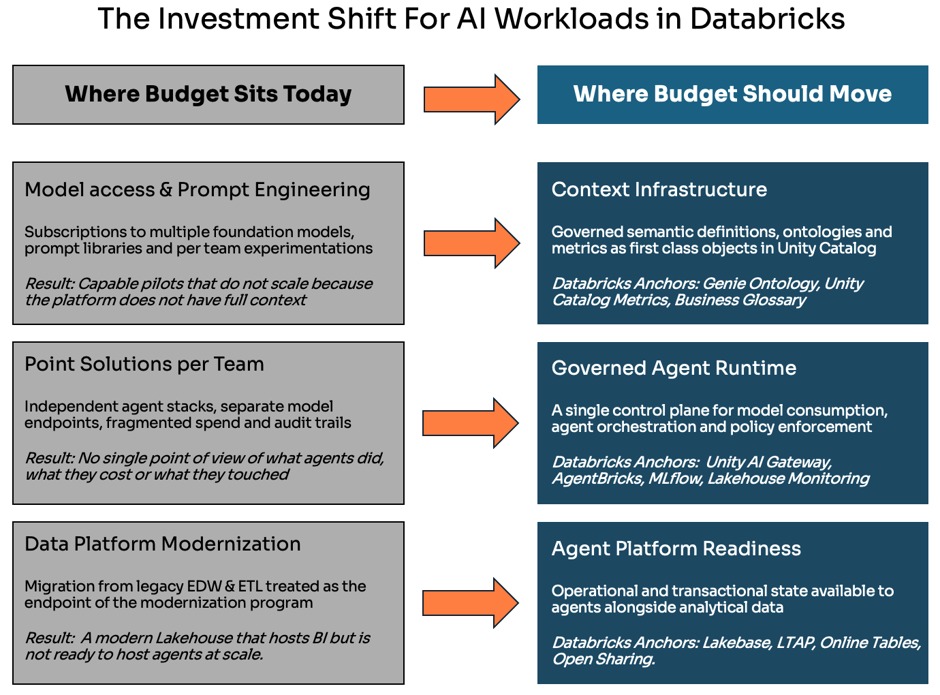
Figure 3. The three shifts that move an enterprise from the current AI posture to a context first posture on Databricks.
The Next Twelve Months
The message that opened Data + AI Summit 2026 was not a marketing line; it was a diagnostic lens. Over the next four quarters, the organisations that scale AI will not be separated from those that stall by model quality or engineering talent alone. The difference will be whether they have turned semantic, operational, and behavioural context into governed infrastructure that agents can use, and whether the supporting controls for cost, governance, and choice have matured at the same pace as AI adoption.
The autonomous enterprise is no longer a future idea. The platform capabilities that enable it are already arriving on Databricks, with many generally available or in advanced preview. The constraint is no longer technology or ambition. It is whether leaders treat context as a core infrastructure investment, applying the same discipline to it that they applied to data platforms over the past decade. Organisations that make this shift in the next twelve months will shape the AI native enterprise. Those that do not will remain in pilot mode.