
We need to talk about the massive elephant in the room: “AI” and “Machine Learning” are easily two of the most exhausting, overused buzzwords of our time. But the goal shouldn’t be to gatekeep these technologies with dense academic jargon; it should be to simplify them so anyone, from a small business owner to a curious non-techie, can actually use them.
Think of traditional software like a cookbook where you give the computer every single step and rule. Machine learning completely flips that script: you give the computer the final dish (the data), and it figures out the recipe on its own.
Take chess, for example:
- The Old Way: You had to hardcode millions of rigid rules telling the computer exactly how to react to every possible move.
- The ML Way: You feed the system thousands of past grandmaster games, and it auto-deciphers the underlying strategies to win.
This shift from rigid rules to adaptive learning is exactly why we are living through an AI explosion. Today, tools like ChatGPT and Gemini are so democratized that a twenty-dollar monthly subscription hands anyone the keys to advanced algorithmic power. As these tools become a seamless part of daily life, we don't need more complex research papers that confuse people. We need simple, human-centric explanations that empower everyone to build, innovate, and adapt.
Understanding the AI and ML landscape
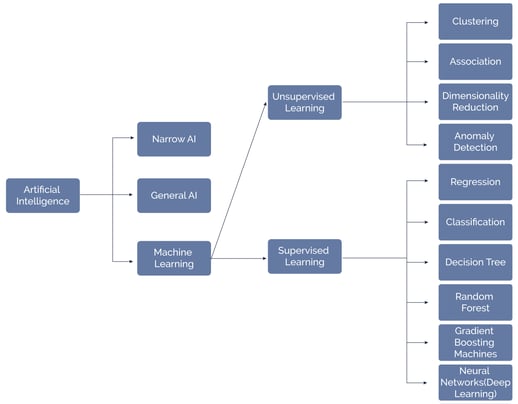
Understanding the current AI and ML landscape is vital. Significant development has occurred over time, and it's worth revisiting some of these concepts. Artificial intelligence often gets confused with machine learning, though the latter is a subset of the former. There are three main subsets of artificial intelligence: narrow AI, which involves machines designed to perform a specific task—like Alexa or Siri, which are voice assistants on your phone; general AI, which involves more complex, Terminator-like machines capable of performing nearly any task a human can; and machine learning. Machine learning is divided into supervised and unsupervised learning.
In this context, applications of AI and ML are best understood as practical business tools rather than abstract technical concepts. That perspective makes it easier to decide when to use simple analytics, machine learning, or broader AI capabilities.
Uncovering Customer to Customer Relationships with AI/ML
Watch now
Supervised learning
Supervised learning, as the name suggests, involves giving a program both inputs and expected outputs, instructing it that whenever it sees similar inputs, the outputs should match the examples given. You provide it with numerous data points and a large dataset so it can understand the trends and the impact of particular data points on the outcomes. The machine then determines the expected output for a given type of input based on various features.
Many machine learning applications begin with supervised learning because it works well when labeled examples are available. This makes it a practical choice for prediction, classification, and pattern recognition problems.
Unsupervised learning
On the other hand, unsupervised learning involves providing the machine with a large amount of data and letting it identify patterns on its own. It uses various algorithms to group and cluster the data, helping reveal underlying trends unsupervised, as illustrated in the accompanying diagram.
Unsupervised learning is especially useful in machine learning practical applications where the goal is to discover hidden structure, such as customer segments or behavior patterns, without predefined labels.
Hot topics in AI and ML
With these foundations, we can also look at some of the hot topics in AI and machine learning.
When people discuss applications of AI and machine learning, the most common examples often include deep learning, NLP, generative AI, and analytics-driven decision support. These areas continue to shape how organizations think about automation and intelligence.
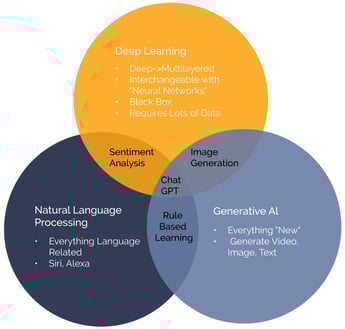
Let's examine some prominent search terms related to AI and machine learning as of 2024. Starting with "deep learning," what exactly does this mean? The term "deep" in deep learning refers to the multiple layers involved in this specific method of training machines. Deep learning is supervised learning where the user provides sets of inputs and desired outputs to the Machine, teaching it to produce the correct outputs from given inputs. The critical distinction in deep learning algorithms is that, unlike traditional algorithms with just two layers (an input and an output layer), deep learning algorithms incorporate multiple layers to handle nuanced outputs that a single layer would struggle with. These intermediate layers are a black box to the user, added by the Machine to enhance the accuracy of its predictions.
Deep learning is employed in solving complex problems like image, text, or voice recognition, where multiple layers are crucial for the Machine to formulate an effective prediction model. The term "neural networks" is frequently used interchangeably with deep learning, referring to the network-like structure of these multiple layers.
In many AI/ML applications, deep learning is used when traditional methods struggle with complex patterns in images, speech, or text. That makes it especially relevant for high-volume, high-variation data problems.
Another commonly used term is "natural language processing" (NLP). NLP is one of the most visible ML applications today because it powers chatbots, search, summarization, and sentiment analysis. It is often the bridge between raw language and usable business insight. NLP processes natural human language to understand and interpret human communication, primarily through text. It involves algorithms that break down speech patterns and are used for applications such as sentiment analysis, text generation, and summarization. NLP encapsulates all activities related to understanding or generating natural language.
The term "generative AI" is currently at its zenith of popularity. For instance, Google's recent enhancements to its Pixel 8 Pro for generating high-quality photos using advanced filters showcase the practical applications of generative AI. This technology involves AI systems that create new content, whether text, images, or videos, by learning from existing patterns. ChatGPT is an example of a technology that synergizes these three areas—utilizing deep learning algorithms, natural language processing, and acting as a part of generative AI by producing new content based on learned data. While it sounds enticing for firms to dive directly into Machine learning, a lot can be accomplished with some of the more basic analytics methods, and it is often the best idea to move forward.
For many organizations, applications of AI and machine learning now include generative systems that can draft content, summarize information, or assist with creative workflows. These use cases are growing because they combine pattern learning with content generation.
We can categorize the analysis process into four main stages: descriptive, diagnostic, predictive, and prescriptive analytics. Each stage serves a distinct purpose and helps businesses understand different aspects of their data:
- Descriptive analytics: This initial stage outlines what has happened by simply describing past data, such as showing a decline in customer acquisition through visual data representation.
- Diagnostic analytics: This stage builds on the descriptive analytics to explore why something happened. It integrates business intelligence to analyze factors like pricing changes, economic impacts, or marketing strategies, determining the causes behind observed trends.
- Predictive analytics: Using the insights from diagnostic analytics, predictive analytics forecasts future outcomes, employing machine learning to predict future trends based on past data.
- Prescriptive analytics: The final analytical stage uses the predictions to suggest actions. It offers strategies to address the anticipated scenarios, recommending specific measures that could influence future outcomes favorably.
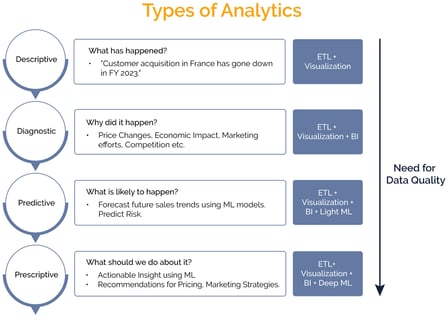
Each analytical stage requires increasingly sophisticated data quality, beginning with complete and accurate data for descriptive analytics and culminating in high-quality, reliable, relevant, and timely data for prescriptive analytics.
These stages show why machine learning applications are only one part of the broader analytics journey. Many organizations get value from descriptive and predictive methods long before they need advanced AI.
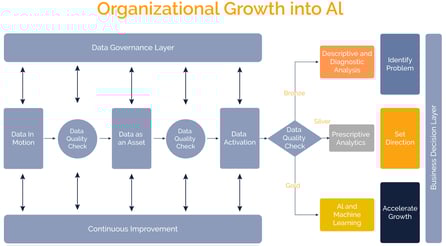
A firm should encourage the above architecture, which focuses on three key pillars of data usage: data in motion, data as an asset, and data activation. The emphasis is on identifying the problem and setting the direction of growth before diving into AI/ML.
In the current day and age, there are multiple ways in which a firm or even a Data analyst can enjoy the benefits that come out of this algorithm –
- Creating your model- With Gemini and Chat GPT now generating increasingly complicated code across multiple languages, anyone familiar with common principles can use these services to build and train their own ML Models for Local use. For teams exploring AI/ML applications, model creation is often most useful when they already have a well-defined problem and reliable data. Without that foundation, even a strong algorithm will produce weak outcomes.
- Use a service- The Big 3 provides state-of-the-art, industry-standard templates that anyone can use to create and train their models with just a single click. This option, however, is financially more expensive than the first one, but it at least gives companies the confidence to boast about these models for accuracy and using leading-edge algorithms. This option is especially useful when businesses want to compare applications of AI and ML without building everything internally. It allows teams to move faster while relying on managed infrastructure and established toolsets.
Let's also look at the current ML market and what the experts say. The graph below from Gartner makes two things very clear for anyone trying to ride the Wave –
- "Generative AI" is currently at the Peak of "Inflated Expectations" and will remain relevant for at least the next 3 to 5 years.
- "Cloud AI Services" are experiencing a rejuvenating period, and the top three players in the industry are Google, Amazon, and Microsoft.
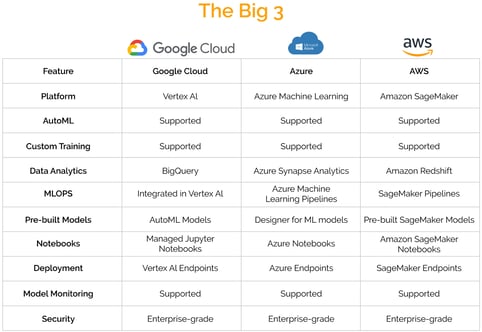
The AI market leaders, including Amazon Web Services, Google Cloud, and Microsoft Azure, provide robust environments for developing and deploying machine learning models. These platforms offer comprehensive services that span from initial model building to deployment, including features for live data processing and batch output predictions, which cater to a wide range of business needs, from real-time recommendations to data analysis.
The growth of applications of AI and ML across cloud platforms has made it easier for businesses to experiment, deploy, and scale models without building heavy infrastructure from scratch. That lowers the barrier to entry for many use cases.
Conclusion
To summarize, the world of machine learning can be for more than just the coders. There are many avenues where noncoders and business experts can leverage this insight.
The most effective machine learning applications are those tied to a real business problem, supported by good data, and aligned with the right level of analytical maturity. That is what turns AI and ML from buzzwords into practical value.
Machine learning need not be the go-to for a firm if it's at the initial stages of identifying its problem, and businesses need to understand that without a certain quality of data, all forms of analytics will give false insights, which will complicate matters further.
Related Webinar