
Key takeaways
- Pharmaceutical organizations spend approximately $30B annually on content, yet 77% of approved field materials are rarely or never used, a structural failure of file-based management.
- The Content Intelligence Operating Model is an 11-stage closed-loop framework that connects ingestion, MLR review, omnichannel distribution, and citation surveillance into a single AI-driven intelligence layer.
- Six compounding operational loopholes from the approved content black hole to reference citation decay are interconnected and cannot be solved in isolation.
- A context-aware knowledge graph decomposes static documents into reusable, claim-level data nodes, enabling modular assembly, impact propagation, and MLR workload optimization.
- The Enterprise Knowledge Fabric is the strategic destination: a self-correcting, self-compounding intelligence layer where commercial knowledge flows continuously from clinical evidence to field conversation to prescribing outcome.
Executive leaders are witnessing a necessary paradigm shift in AI content management: the transition from managing content as static files to orchestrating content as interconnected knowledge. This shift is redefining agility, compliance, and field effectiveness across the pharmaceutical enterprise.
Introduction and market context
What is content lifecycle management?
Pharmaceutical content lifecycle management is the end-to-end strategic governance of medical, scientific, and promotional materials — from initial creation and Medical-Legal-Regulatory (MLR) review through omnichannel distribution, engagement tracking, and compliant retirement. It leverages structured metadata and AI to ensure materials are accurate, compliant, and impactful at every stage.
The urgency to modernise pharmaceutical content lifecycle management has never been more pronounced. For decades, the industry's reliance on file-based storage systems has created compliance risks, restrained field effectiveness, and limited market agility. Global organisations continue to manage high-value scientific and commercial assets in isolated, fragmented repositories. Critical promotional materials management is hampered because files, approved claims, historical MLR approvals, and clinical references are completely disconnected, making semantic content discovery impossible.
|
~$30B* estimated global pharma content spend per year |
77% of approved field content is rarely or never used |
|
7% / 29% global / U.S. increase in content production in 2023 and the pace is not slowing |
25k+ new pieces of CLM content pushed to CRM every week at large biopharma brands |
* Source: Veeva, “Building the Future of MLR with AI: Fastest Path to Approved Content,” 2025, citing Healthgrades 2024 Outlook, Veeva Pulse Content Metrics & Veeva Content Benchmark data.
This traditional, reactive paradigm inevitably breaks under the sheer scale of modern omnichannel programmes and the accelerating demand for field personalisation. Today's commercial reality requires disseminating hyper-targeted content across field reps, web platforms, targeted email campaigns, HCP portals, congress booths, and direct-to-patient channels simultaneously. Consider a modern oncology brand: it may support dozens of tumour types, each with distinct lines of therapy, biomarker profiles, payer dynamics, and specialised HCP audiences.
Every distinct combination requires tailored materials. Meanwhile, field medical, market access, patient services, and digital health teams generate thousands of content requests concurrently. Managing this volume safely, effectively, and cohesively is arguably the defining operational challenge for pharma marketing operations today. For competitive product launches, any delay translates directly to lost market share. The solution is not merely buying larger storage arrays; it is fundamentally transforming how we conceptualise pharmaceutical content.
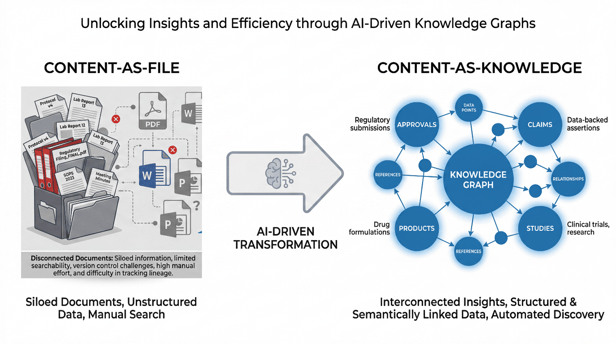
Figure 1: The content transformation from siloed files to a unified, interconnected semantic fabric powered by AI-driven knowledge graphs.
The Content Intelligence Operating Model
Modern content governance requires a systemic, architectural approach rather than a patchwork of point solutions. The Content Intelligence Operating Model represents a closed-loop system, intelligently connecting ingestion, semantic enrichment, automated review, dynamic deployment, behavioural measurement, and continuous retirement into a single, unified intelligence layer.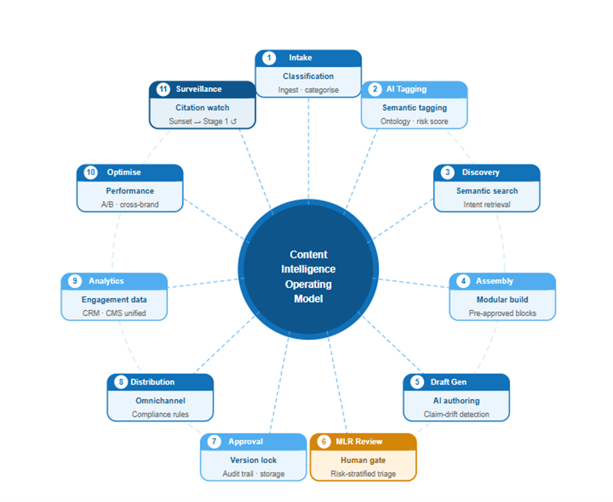
|
1 |
Content intake & classification Automated ingestion of diverse content types with smart, rules-based categorisation inside a unified governance framework. |
|
2 |
AI-powered tagging Leveraging AI for intelligent metadata application: clinical entity extraction, taxonomy mapping, ontology alignment, and preliminary risk scoring. |
|
3 |
Semantic discovery Unlocking hidden insights through advanced search and relation analysis bypassing keyword limitations so field and medical teams surface contextually relevant assets by intent.
|
|
4 |
Modular assembly Component-based creation for reuse across channels and materials, constructing multi-channel outputs from pre-approved, composable blocks covering efficacy, safety, mechanism of action, and audience-specific messaging. |
|
5 |
Draft generation AI-assisted authoring and auto-population of content templates, with real-time claim-drift detection before a document reaches human review. |
|
6 |
MLR review loops Streamlined Medical, Legal, and Regulatory collaboration with feedback tracking. AI risk-stratifies content: low-risk modular combinations are fast-tracked; novel or high-risk claims are escalated for intensive human review. |
|
7 |
Approval & version lock Finalising approved assets and securing content integrity with audit trails, version guarantees, and secure asset storage across the global repository. |
|
8 |
Distribution orchestration Controlled dissemination across multi-channel platforms, enforcing channel-specific compliance rules that separate patient-facing non-promotional content from HCP-targeted clinical materials. |
|
9 |
Engagement analytics Measuring performance and user interaction data by unifying CMS, CRM, and real-time engagement signals to attribute specific module usage to verifiable HCP behavioural shifts. |
|
10 |
Performance optimisation Iterative improvements based on data-driven insights: A/B testing frameworks, cross-brand intelligence learning, and continuous strategic refinement. |
|
11 |
Citation surveillance & retirement → Stage 1 Real-time surveillance of FDA alerts, PubMed, ClinicalTrials.gov, and academic retractions. When underlying evidence shifts, the system triggers sunset-and-refresh protocols and re-enters the cycle at Stage 1. |
When operating concurrently, these 11 stages eradicate the silos that have traditionally separated the creative agency from the MLR committee, and the field representative from the data analyst.
“The shift from content-as-file to content-as-knowledge is not optional, it is a compliance and competitive imperative.”
Six critical content operational loopholes
Despite massive investments in digital asset management repositories, commercial organisations rely heavily on file-based management constructs that introduce invisible operational blind spots. These loopholes do not exist in isolation. They form an interconnected, compound cascading problem structure.
An approved content black hole directly feeds into an engagement measurement mirage (you cannot measure what field reps cannot find). A modular content paradox triggers dangerous cross-channel compliance drift. An MLR throughput bottleneck dramatically amplifies the risk of reference citation decay, as overwhelmed review teams lack the bandwidth to perform systematic surveillance.
1. Approved content black hole
|
The risk |
Highly valuable, approved content becomes completely undiscoverable due to primitive, flat metadata in file-based storage systems. |
|
Why it persists |
Search architecture relies on filename conventions and exact keyword matches rather than genuine semantic understanding of therapeutic context. |
|
Operational effect |
Field reps cannot locate the precise modular piece needed to overcome a specific HCP objection or navigate a nuanced payer scenario, resulting in lost interactions. |
|
AI-enabled remedy |
Advanced semantic tagging using AI ensures all legacy and new assets are contextually indexed, transforming a “search” function into an intelligent “retrieval and assembly” function. |
2. Modular content paradox
|
The risk |
The theoretical promise of “modularity” collapses when new, minor combinations of previously pre-approved modules arbitrarily trigger entirely new, full-length MLR review cycles. |
|
Why it persists |
Legacy systems possess no structural memory or compositional rules. They cannot mathematically prove to an MLR reviewer that the juxtaposition of Module A and Module B maintains the original approved context. |
|
Operational effect |
The organisation pays for the complexity of modular design but reaps none of the speed benefits. Veeva customer data shows that optimised modular workflows can reduce approval times by up to 30% savings unavailable under file-based systems. |
|
AI-enabled remedy |
An AI content management engine actively validates existing approved modules against predefined compositional rules, fast-tracking historically unchanged combinations and auto-escalating only when novel claim drift is detected. |
3. MLR throughput bottleneck
|
The risk |
The sheer volume of omnichannel asset variations vastly outpaces human reviewer capacity, slowing down the promotional supply chain. |
|
Why it persists |
Human reviewers (Medical, Legal, Regulatory) are forced to manually verify every single element repeatedly, treating every document as a completely novel entity. |
|
Operational effect |
Complex brands can generate tens of thousands of content requests per quarter. The resulting bottleneck causes extended MLR cycle times, costly launch delays, and an inability to respond to payer landscape shifts. Industry data shows that optimised MLR workflows have achieved a 57% reduction in review cycle times (Veeva Pulse Metrics). |
|
AI-enabled remedy |
MLR automation triages drafts instantaneously, auto-flagging specific compliance deviations and high-risk patterns, thereby reducing manual cognitive load and accelerating average review time. |
4. Engagement measurement mirage
|
The risk |
Pharma operations teams track metrics such as views, clicks, and downloads rather than linking content utilisation to actual prescribing outcomes. |
|
Why it persists |
The data ecosystem is fractured. CRM data, CMS analytics, and downstream prescription data sit in isolated, un-joined data lakes. |
|
Operational effect |
Millions are spent on campaign variations without knowing which specific clinical claim moved the behavioural needle for a specific HCP segment. |
|
AI-enabled remedy |
Deploying closed-loop analytics through a unified graph ties specific module and claim usage to verifiable field effectiveness, using event stream analysis to isolate the contribution of the content asset. |
5. Cross-channel compliance drift
|
The risk |
A core clinical message gets manually adapted across disparate formats such as rep-triggered email, patient portal, congress booth causing unintended claim inconsistencies. |
|
Why it persists |
Different channels have vastly different regulatory constraints. For example, patient materials cannot include certain efficacy claims without extensive fair balance. |
|
Operational effect |
Regulatory exposure skyrockets as subtly altered claims bleed into highly regulated public channels, risking FDA warning letters and financial penalties. |
|
AI-enabled remedy |
Automated content governance enforces channel-specific deployment rules at the exact point of distribution orchestration, preventing non-compliant content from reaching regulated channels. |
6. Reference citation decay
|
The risk |
Active, in-market promotional materials continue to cite clinical studies that have subsequently been updated, revised, or outright retracted. |
|
Why it persists |
Once a document is approved, it becomes static. No human team has the bandwidth to manually cross-reference thousands of active assets against daily updates in global medical literature. |
|
Operational effect |
The brand may unwittingly promote claims based on superseded safety data, jeopardising patient safety and creating significant regulatory liability. |
|
AI-enabled remedy |
Continuous citation surveillance automatically polls external databases including PubMed, ClinicalTrials.gov, and FDA alerts. When a foundational reference decays, the graph instantly traces the relationship and triggers a “sunset and recall” protocol for every impacted downstream asset. |
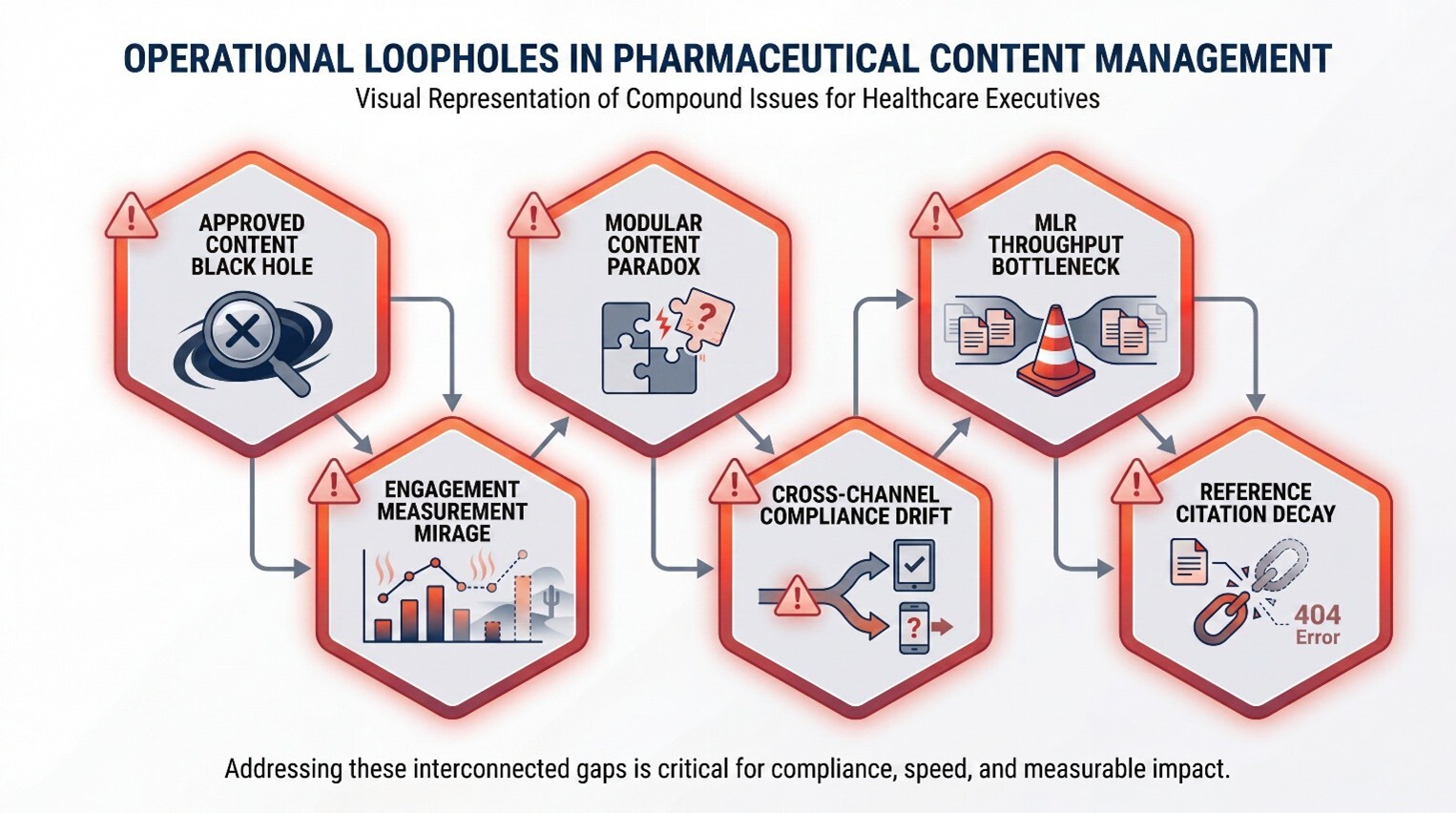
Figure 3: The compounding operational loopholes and their cascading effects in commercial pharmaceutical operations.
How the Enterprise Knowledge Fabric transforms content operations
The foundational leap required to truly modernise the pharmaceutical content lifecycle requires moving away from the “document” as the primary unit of enterprise management. A context-aware knowledge graph in healthcare architectures breaks static files down into their molecular components. Within a graph, a document is a dynamic constellation of individual approved claims, specific supporting evidence, historical MLR approvals, clinical references, target audiences, and contextual relationships.
A knowledge graph is the structural foundation. The strategic destination for leading pharma commercial organisations is the Enterprise Knowledge Fabric: the state where the graph is the connective tissue that governs how commercial knowledge flows, compounds, and self-corrects across the entire organisation: from clinical evidence to field conversation to prescribing outcome, in a continuous loop.
The distinction is operationally significant. A knowledge graph answers questions: it tells you what a claim means, who approved it, and where it has been used. An Enterprise Knowledge Fabric acts: it detects a label change, traces every downstream asset affected, routes updates through the appropriate MLR fast-track, and ensures field teams receive revised materials before the next HCP interaction, without a human initiating any of those steps.
When implemented correctly, the Enterprise Knowledge Fabric transforms disparate data silos into a unified semantic layer, yielding six transformational operational capabilities:
- Claim provenance and reusability: Teams can instantly trace any specific marketing statement directly back to its foundational clinical trial data and its entire historical chain of MLR approvals.
- Impact propagation for clinical updates: When a clinical study is revised or a label is updated, the graph acts as a neural network. It automatically highlights every single downstream content asset that relies on that specific data point, eliminating manual guesswork in impact analysis.
- Personalised content assembly at scale: By mapping HCP attributes against specific clinical claims, the graph can dynamically generate hyper-personalised materials tailored to an HCP’s previous engagement profile, prescribing habits, and specific specialty focus.
- Cross-brand intelligence: The graph breaks down brand silos, allowing enterprise teams to share successful messaging frameworks, modular templates, and proven compliance safeguards across entirely different therapeutic business units.
- MLR workload optimisation: The graph drastically reduces review friction. It provides MLR reviewers with a visual lineage, explicitly proving that a specific claim context has been previously cleared thereby accelerating modular content review.
- System-guided decision support: The infrastructure fundamentally shifts content governance from manual human policing to a system of reusable, automated compliance memory.
“The knowledge graph is the architecture. The Enterprise Knowledge Fabric is what that architecture becomes when it is woven across the entire commercial enterprise and it is self-correcting, self-compounding, and always current.”
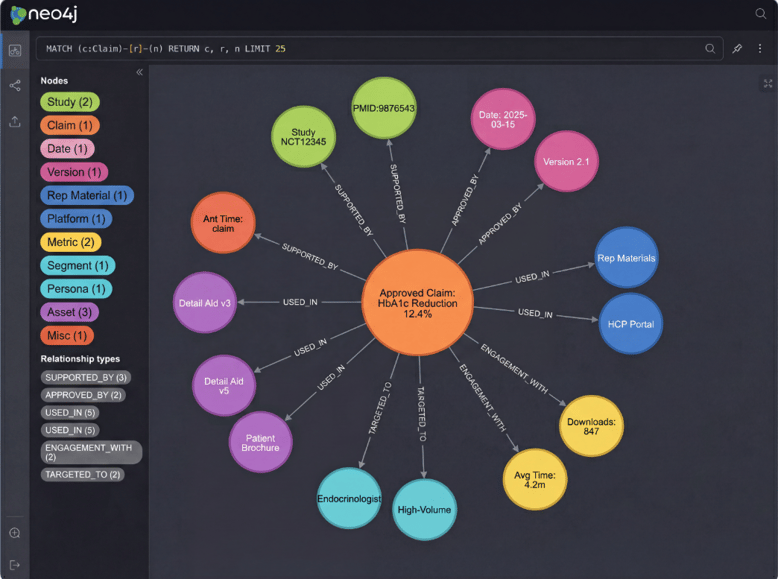
Figure 4: A context-aware knowledge graph connecting claims, studies, approvals, and engagement data.
From generic pipeline to pharma-calibrated intelligence
Deploying the Enterprise Knowledge Fabric in pharma requires deliberate calibration at every stage because the pipeline as designed is domain-agnostic, and pharmaceutical content is one of the most domain-specific data environments in any regulated industry. A generic pipeline ingests invoices and contracts. A pharma pipeline must ingest CSRs, SmPCs, label updates, and MLR dossiers, each with distinct regulatory conventions that off-the-shelf models cannot handle without rigorous fine tuning.
Calibration requirements for Pharma content by each stage
Document Intake: Generic OCR and layout parsers are trained on standard business documents. Pharma regulatory documents use specialised typographic conventions such as structured safety tables, footnoted references, boxed warnings, and multi-column SmPC layouts that standard layout models misparse, corrupting downstream extraction. Pharma implementations require layout models fine-tuned on regulatory document corpora, with explicit recognition of safety sections, indication statements, and fair-balance language blocks.
Extraction (NER, Intent Analysis, Classification): Standard Named Entity Recognition models identify people, places, and organisations. Pharma NER must identify: INN drug names and brand synonyms, biomarker identifiers (e.g. HER2+, PD-L1 expression thresholds), MedDRA-coded adverse event terms, ICD-10 indication codes, clinical endpoint types (primary, secondary, exploratory), and statistical significance markers (p-values, confidence intervals, hazard ratios) and so on. Without pharma-specific NER, the extraction layer produces structurally sound but semantically hollow data nodes — and the knowledge graph built on top of them will surface inaccurate retrieval results for field teams.
Semantic (Ontology, Relation Map, Data Lineage): Generic ontologies are not fit for pharma claims governance. The semantic layer must be aligned to established pharmaceutical ontologies such as SNOMED CT, MedDRA, RxNorm, and FHIR-compliant data models so that claims extracted from a CSR can be automatically related to their regulatory submission context, their MLR approval history, and their downstream promotional usage. Data Lineage at this stage must capture not just provenance (“this claim came from Study X”) but regulatory lineage (“this claim was approved under label version Y, for indication Z, in market M”).
Context-aware Knowledge Graph: In a generic pipeline, the graph connects entities, claims, and policies. In a pharma implementation, the graph must encode a richer relationship schema: drug ↔ indication ↔ biomarker ↔ line of therapy ↔ clinical endpoint ↔ approved claim ↔ MLR approval version ↔ market ↔ channel ↔ HCP audience segment. Critically, the graph must treat every edge as a versioned, time-stamped relationship because a claim that was valid under label version 3.1 may be non-compliant under label version 3.2, and the graph must surface that distinction at the moment of content assembly, not after distribution.
Multimodal RAG (Vector DB, Semantic Search, LLM Reasoning): The LLM Reasoning layer powering field retrieval must be constrained to approved content boundaries. A general-purpose LLM will hallucinate clinical claims if not architecturally restricted to retrieve only from the MLR-approved node set within the knowledge graph. Pharma RAG implementations must enforce retrieval guardrails: every generated response must be traceable to a specific approved claim node, with its MLR approval ID and source document surfaced alongside the answer. This is the difference between a RAG system that assists field reps and one that creates regulatory liability.
Integration & Value Output: Generic REST APIs and webhooks output data. Pharma integration must output compliance-attributed data: every insight, auto-workflow trigger, and auditability record must carry its chain of regulatory custody which market approved it, under which label version, for which audience, via which channel. Traceability in the Value Output stage is not a reporting feature in a regulated pharmaceutical environment; it is the audit trail that stands up to FDA inspection.
The investment decision is not whether to adopt it, but how to configure each stage for the regulatory specificity that pharmaceutical content demands. Organisations that deploy a generic pipeline and expect pharma-grade outcomes will encounter the same six operational loopholes described earlier, now compounded by model misalignment at the extraction and semantic layers, rendering the knowledge graph structurally sound but commercially unreliable.
The table below summarises the calibration requirements for each pipeline stage in a pharma context:
|
Stage |
Generic default |
Pharma calibration required |
|
Document Intake |
Invoices, contracts, emails, standard forms
|
CSRs, SmPCs, Prescribing Information, MLR dossiers; layout models fine-tuned on regulatory corpora to recognise safety sections, boxed warnings, and fair-balance blocks |
|
Extraction |
NER for people, places, orgs |
Pharma NER: INN drug names, MedDRA AE terms, biomarker IDs (HER2+, PD-L1), ICD-10 codes, clinical endpoints, p-values, hazard ratios |
|
Semantic |
Generic ontologies, relation mapping |
NCI Thesaurus, SNOMED CT, MedDRA, RxNorm, FHIR; regulatory lineage (label version → indication → market → channel) as first-class graph edges |
|
Knowledge Graph |
Entity, claim, policy graph |
Versioned, time-stamped edges: drug ↔ indication ↔ biomarker ↔ approved claim ↔ MLR version ↔ market ↔ channel ↔ HCP segment |
|
Multimodal RAG |
Open-ended LLM retrieval General semantic search No claim-level guardrails |
Retrieval guardrails: LLM restricted to MLR-approved nodes only; every response traces to an approved claim ID — hallucination of clinical claims is a regulatory event, not a quality issue |
|
Integration & Output |
REST APIs, webhooks, analytics |
Every output carries its regulatory custody chain (market, label version, audience, channel); Traceability is the FDA-inspectable audit trail — not a reporting feature |
“A generic content pipeline extracts information. A pharma-calibrated pipeline extracts regulated intelligence, and this difference determines whether your Knowledge Fabric is a competitive asset or a compliance liability.”
Conclusion: Content as a compounding strategic asset
The era of treating pharmaceutical content creation as a disposable, highly manual cost centre is nearing an end. To compete in today’s landscape, every approved claim, every MLR decision, and every field engagement signal must become a reusable, intelligent asset that compounds in value over time.
“The fastest path to value is not a full rip-and-replace, but a governed intelligence layer built incrementally that compounds what the organisation already knows.”
For executive leadership, the strategic mandate is clear: orchestrate a shift from document-centric repositories to claim-centric intelligence ecosystems. Start with one highly measurable transformation programme. Begin by classifying legacy archives, enriching them with claim-level semantic tags, and connecting them through a healthcare context-aware knowledge graph. Use this semantic foundation as the strategic bedrock to modernise modular authoring, scale MLR automation, and execute true omnichannel reuse.
By weaving your disparate content assets into a unified strategic intelligence fabric, you secure not just compliance but competitive agility. The organisations that close this gap fastest are those that set their sights beyond the knowledge graph as a destination. The knowledge graph is the foundation. The Enterprise Knowledge Fabric where commercial knowledge flows, compounds, and self-corrects continuously across every function, system, and field interaction is the competitive architecture that will define the evolution of pharma commercial excellence.
“Every approved claim your organisation has ever cleared is a potential asset or a future liability. The difference is whether it is connected.”
Frequently asked questions
What is pharmaceutical content lifecycle management?
Pharmaceutical content lifecycle management is the end-to-end governance of medical, scientific, and commercial promotional materials. It spans initial creation and MLR review through omnichannel distribution, engagement tracking, and compliant retirement leveraging structured metadata and AI to ensure materials are accurate, compliant, and impactful at every stage.
What is the Content Intelligence Operating Model?
An 11-stage closed-loop framework that shifts content operations from reactive, siloed file management to a proactive AI system. It connects asset classification, intelligent MLR triage, controlled omnichannel distribution, and continuous clinical citation surveillance into a unified intelligence layer.
How does AI reduce MLR review time in pharma?
AI slashes MLR review time by automating pre-screening and triage. It enforces compositional rules and risk-stratifies content, routing previously approved modular combinations into automated fast-tracks and flagging only genuinely novel claims for human review. Optimised MLR workflows have achieved a 57% reduction in review cycle times (Veeva Pulse Metrics, 2024).
What is the difference between taxonomy and ontology in pharma content?
Taxonomy provides a hierarchical categorisation of terms. Ontology defines the multi-directional semantic relationships between concepts linking a specific drug to its clinical claims, regulatory approval history, adverse events, and prescriber audiences simultaneously.
How do knowledge graphs improve content reusability?
Knowledge graphs decompose static documents into interconnected data nodes representing individual approved claims, their clinical evidence, and their MLR approvals. This empowers teams to search for and reuse specific, pre-approved statements across new formats without triggering full review cycles.
What are the biggest challenges in pharmaceutical content management?
The most critical challenges are maintaining regulatory compliance at scale, ensuring content findability for distributed field reps, managing MLR review bottlenecks, preventing cross-channel compliance drift, and attributing digital content engagement to concrete prescribing outcomes.
Why do companies struggle with modular content reuse in pharma?
File-based systems lack compositional rules. Without a graph-driven governance layer, reassembling pre-approved modules into a new format can trigger unintentional claim drift or cross-channel compliance violations, eliminating the speed benefit that modular design promises.
What is pharma content compliance automation?
Pharma content compliance automation uses AI and knowledge graph infrastructure to enforce regulatory rules at every stage of the content lifecycle from claim validation during authoring to channel-specific deployment controls and real-time citation surveillance, reducing reliance on manual review.