
A Data Maturity Model Assessment helps organizations evaluate their current level of data capability and maturity across various dimensions, such as data governance, quality, integration, and analytics. This assessment aims to identify your organization's current data maturity level and create a roadmap to progress to higher stages of maturity.
A modern data maturity assessment should also evaluate AI readiness, DataOps maturity, and LLM/GenAI readiness, since these capabilities increasingly influence how organizations operationalize data. This broader view makes the data maturity model more relevant to current business and technology priorities.
Why it matters
Knowing your maturity level allows you to understand the strengths and weaknesses of your current data strategy and identify areas that need improvement. Moving up in maturity enables your organization to use data more effectively and gain competitive advantages through better insights and decision-making.
The right data strategy assessment can also show how maturity translates into business value by linking improvements in governance, quality, and analytics to measurable ROI. This helps organizations understand not just where they stand, but what benefits they can expect as they move up the maturity curve.
Data maturity levels
While different models may use different terms, here is a common five-level framework for data maturity:
- None: No processes or practices are in place. The organization is unaware of the need for improvement or has not yet started addressing the domain in question.
- Basic: Initial processes are introduced, but they are informal, often undocumented, and vary across the organization. Basic awareness of the need for improvement exists, but efforts are limited.
- Intermediate: Some formal processes are established and documented. There is consistency in process implementation across parts of the organization, but improvements and scalability are needed.
- Advanced: Processes are well-documented, standardized, and implemented consistently across the organization. The organization actively manages and optimizes its practices based on data and analysis.
- Optimized: Processes are fully optimized and integrated into the fabric of the organization. The organization seeks continuous improvement through innovation and learning. It adapts quickly to changes and leads industry best practices.
In practice, organizations may also assess whether governance is centralized or federated, since the right model depends on operating structure and scale. A data maturity framework that considers both can better reflect how real enterprise teams manage ownership and control.
Key areas for assessment
A complete data analytics maturity assessment should look beyond core governance and include emerging capabilities such as DataOps, AI readiness, and data product thinking. When conducting a Data Maturity Model Assessment, it’s essential to evaluate the following key areas comprehensively.
- AI readiness: Assess whether the organization has the data, processes, and governance needed to support AI use cases at scale.
- DataOps maturity: Review how well the organization automates testing, deployment, monitoring, and operational data pipelines.
- Data product maturity: Evaluate whether data assets are managed as reusable products with clear ownership, quality standards, and business value.
- LLM/GenAI readiness: Determine whether the organization has trusted, accessible, and well-governed data needed to support LLM and GenAI initiatives.
- Governance operating model: Assess whether governance maturity is centralized, federated, or hybrid, and how effectively it supports decision-making.
Questionnaires for assessment
An effective questionnaire serves as the foundation for a comprehensive and successful maturity model assessment. Tailored to your organization's unique needs, a well-crafted set of questions can uncover critical insights and nuances about your data practices.
At Mastech, we collaborate with your SMEs and Business teams to customize our extensive questionnaire bank, ensuring relevance and focus for your specific requirements. Each Questionnaire Area is meticulously structured, with questions organized into smaller, manageable sections. These sections are further enriched with detailed descriptions and real-world examples to provide clarity and context for participants, facilitating a deeper understanding and more accurate responses.
These additional dimensions help create a more complete data maturity assessment by connecting current-state practices with future-state priorities. They also make it easier to tailor the questionnaire to different business units and technology teams.
Below is an example from the Data Governance Overview area:
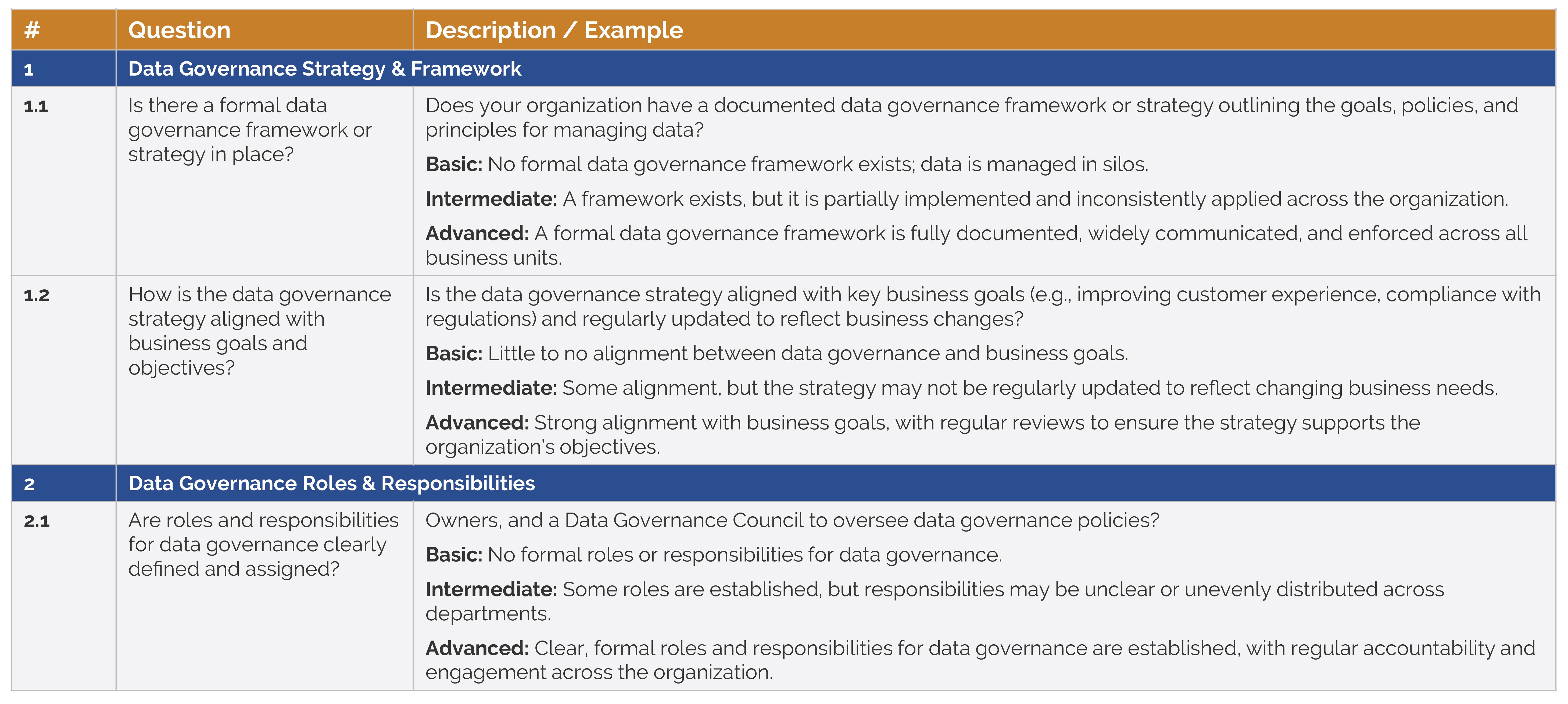
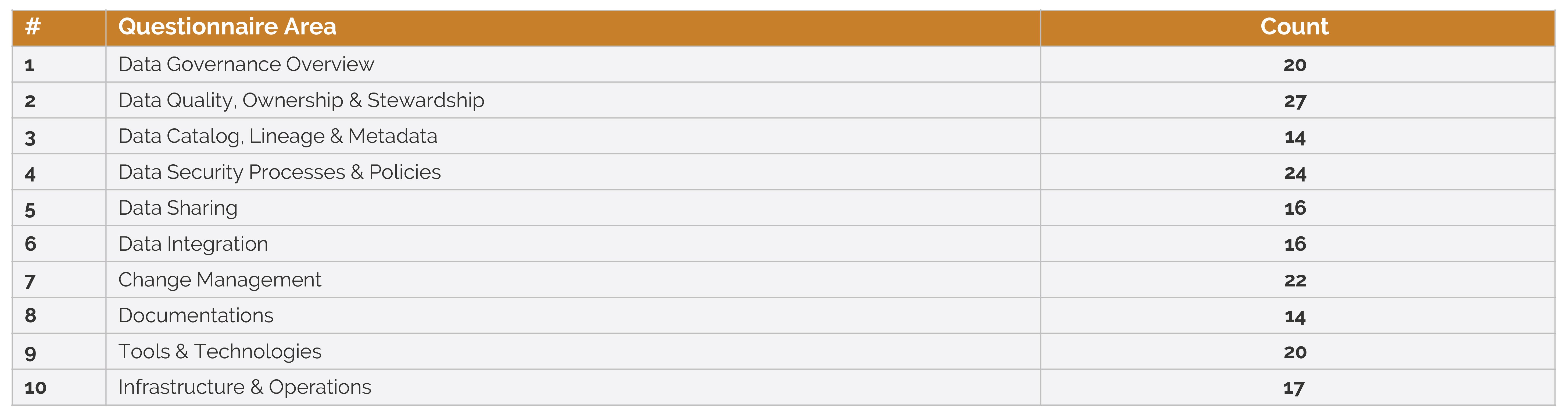
The questionnaire selection process is designed to strike a balance between capturing comprehensive details and minimizing the effort required from participants. This ensures meaningful insights are gathered without overwhelming the contributors. Typically, the process results in a carefully curated set of approximately 200 to 250 questions covering all critical areas.
Below is an illustrative breakdown:
Assess your organization’s maturity level
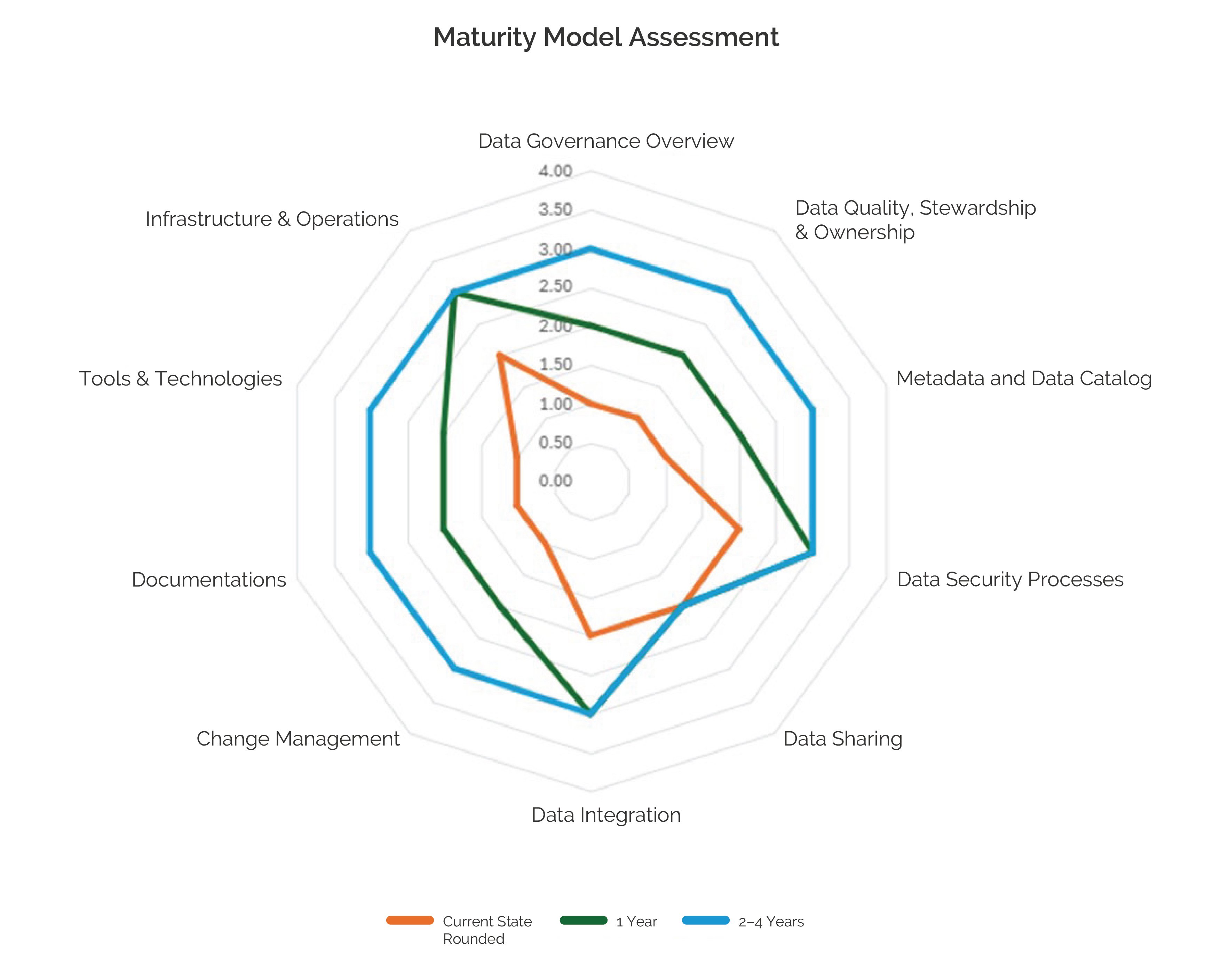
Determining your organization’s data maturity level involves a systematic evaluation of key areas in your data strategy, such as governance, quality, security, and integration. By benchmarking each area against defined maturity levels, you can identify your current state and establish where you aim to be in the short term (1 year) and long term (2–4 years).
We aggregate self-assessment scores from individual questions across all areas to create a comprehensive Maturity Model. These scores are then compared against the expected maturity levels for your organizational goals. The results provide a clear visual representation of gaps and opportunities, enabling focused efforts for improvement.
When possible, maturity scoring should be tied to practical outcomes such as cycle time, adoption, automation, and business impact. This makes the data maturity discussion more actionable and helps teams prioritize the next best investments.
An example of this evaluation is depicted using a radar chart below. This chart highlights current maturity levels versus targeted short—and long-term goals. This visualization facilitates strategic discussions and helps prioritize initiatives for progressing along the maturity spectrum.
Conclusion
A Data Maturity Model Assessment is more than just an evaluation; it’s a transformative exercise that provides actionable insights into your organization’s current state and sets a clear path for improvement. By assessing key areas such as governance, quality, security, and integration, you can identify strengths, address gaps, and unlock the true potential of your data strategy.
A strong data maturity model should not only show where the organization is today, but also how ready it is for AI, DataOps, and future data products. That future-focused view turns maturity scoring into a real roadmap rather than a static assessment.
Whether you’re looking to optimize your current data capabilities or prepare for a more data-driven future, we’re here to help. Contact us today to embark on your data maturity journey!