



Introduction: The healthcare crossroads — predictive or reactive?
For decades, the dominant approach to patient care has been reactive — treat the illness after symptoms emerge. But what if we could intervene before the crisis? What if we could predict adverse outcomes and act proactively?
Thanks to the transformative power of artificial intelligence (AI) and predictive analytics, a future of smarter, more anticipatory healthcare is not only possible — it's already taking shape. Predictive healthcare analytics is ushering in a new care era, enabling us to forecast clinical risks and personalize treatment pathways. This is how AI is revolutionizing the way we care for patients, making it not just about treating illness but about maintaining health.
A modern AI predictive analytics in healthcare strategy should also account for data integration, clinical trust, and the realities of regulated environments. That is what turns prediction into usable care support.
This blog explores how predictive models powered by AI are reshaping patient care, the limitations of reactive systems, and why the future belongs to smart, data-driven healthcare.
The problem with reactive care: High cost, low precision
Reactive care is the long-standing norm: a patient feels unwell, seeks help, and receives treatment based on symptoms. While this model is straightforward, it is also fundamentally limited, often leading to late interventions and increased costs.
Key challenges of reactive care:
- Late intervention often worsens outcomes, especially in chronic or progressive conditions
- Increased costs due to emergency visits, hospitalizations, and unmanaged complications
- Operational inefficiencies from unpredictable patient loads and crisis-based resource allocation
- Burnout among clinicians who are overwhelmed by preventable emergencies
In essence, reactive care treats illness, not health. It responds to what has already gone wrong—missing crucial windows where prevention or early intervention could make a profound difference.
In contrast, predictive care aims to intervene earlier by identifying risk signals before they become emergencies. That shift can improve outcomes while reducing avoidable costs and strain on care teams.
Enter predictive healthcare analytics: A smarter way forward
Predictive analytics leverages historical and real-time data to anticipate future health events. When powered by AI, these analytics can detect subtle patterns across massive datasets—patterns that would be invisible to the human eye.
AI-driven predictive analytics in healthcare includes:
- Machine learning models that analyze patient histories to forecast complications
- Natural language processing that extracts insights from clinical notes
- Time-series analysis from wearable devices to monitor chronic conditions
These technologies move healthcare upstream—identifying risk before symptoms appear, enabling clinicians to make data-informed decisions about prevention, monitoring, and early intervention.
The best AI in healthcare predictive analytics solutions combine historical data, real-time signals, and clinical context to generate more actionable risk insights. This makes predictions more relevant to day-to-day care delivery.
Key differences: Predictive vs. reactive models
Predictive models look ahead to estimate what is likely to happen, while reactive models respond after the event has already occurred. In healthcare, that difference can separate early intervention from delayed treatment.
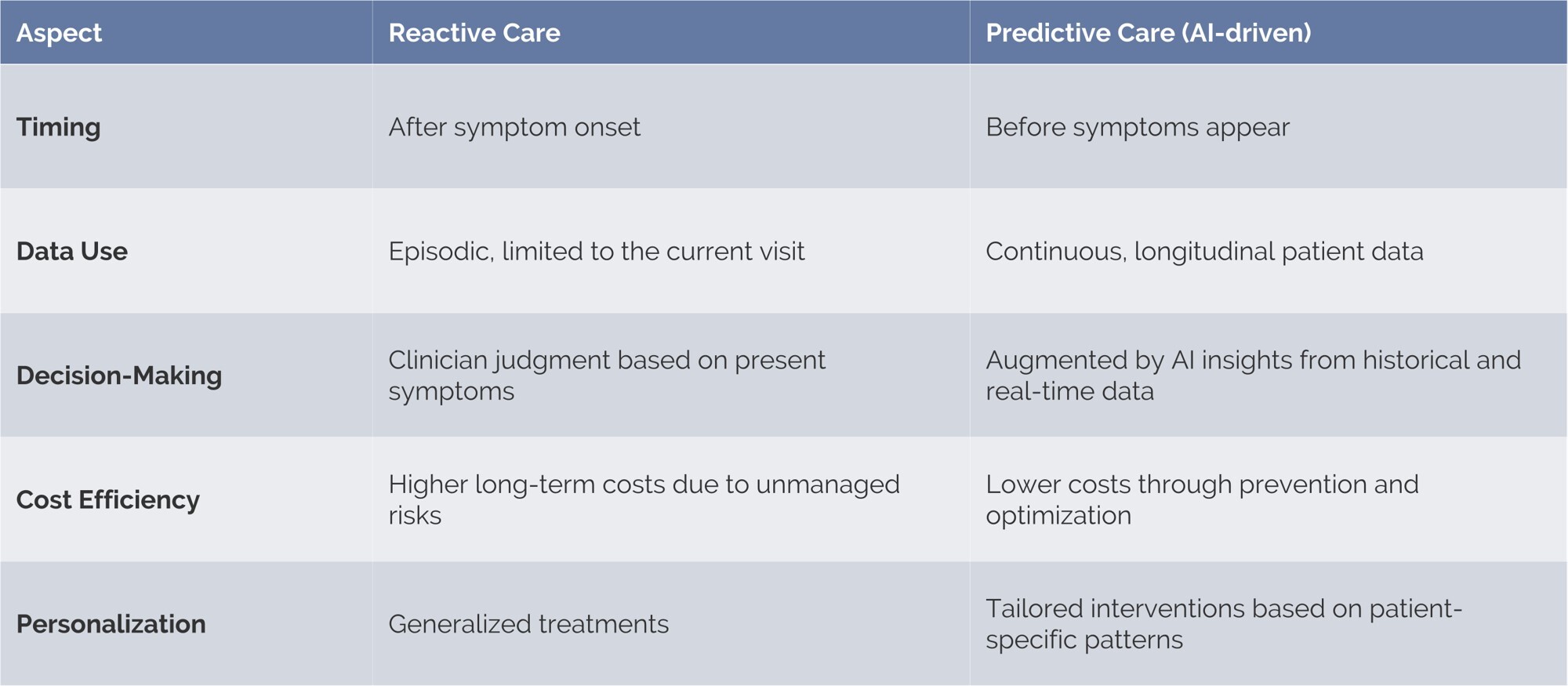
Real-world use cases of AI-driven predictive analytics in action
Predictive models are already transforming care across settings:
- Sepsis detection: AI models detect early signs of sepsis hours before traditional methods, saving lives and ICU costs.
- Readmission risk: Hospitals use predictive tools to flag patients likely to be readmitted and design targeted discharge plans.
- Chronic disease management: AI forecasts flare-ups in patients with diabetes or COPD based on vitals, lab results, and behavior data.
- Emergency care optimization: Predictive triage models help ERs manage high patient volumes by prioritizing cases more accurately.
These use cases are increasingly powered by healthcare predictive models that support risk scoring, intervention planning, and care prioritization. Their value is highest when they are embedded directly into clinical workflows.
These examples demonstrate that predictive analytics isn’t just a theoretical concept — it’s a practical, powerful tool already making a significant impact on healthcare. It's not just about potential; it's about real, tangible results that improve patient outcomes and reduce healthcare costs.
Benefits of predictive analytics for patients, providers & payers
The benefits of predictive care ripple across the healthcare ecosystem, offering timely interventions for patients, reducing stress for providers, and lowering healthcare costs for payers.
Patients:
- Timely interventions improve health outcomes and reduce complications.
- Personalized care plans enhance satisfaction and trust in care providers.
Providers:
- Fewer emergencies and avoidable hospitalizations reduce clinician stress.
- Data-driven insights support more confident, accurate decision-making.
Payers:
- Prevention-focused models lower healthcare costs.
- Better risk stratification supports value-based care and reimbursement.
For health systems, AI-driven predictive healthcare for clinical decision-making is most valuable when it improves both outcomes and operational efficiency. That is why adoption often starts with high-impact use cases such as readmission prevention and sepsis detection.
Ultimately, predictive care shifts the focus from treating illness to maintaining health — a foundational goal of modern medicine.
The technology behind the shift: How AI makes it possible
Predictive analytics relies on a combination of advanced technologies:
- Machine learning algorithms that continuously refine risk models as new data arrives.
- Natural language processing (NLP) to mine unstructured clinical notes and extract valuable health indicators.
- Data streaming and cloud computing to process large datasets in real-time.
- Explainable AI (XAI) frameworks that help clinicians understand model outputs and trust the results.
Clinical notes are a major opportunity here because Clinical NLP on unstructured EHR data can unlock valuable information that is often hidden in free text. This gives predictive models a much richer view of the patient journey.
These innovations enable a dynamic care model where risk scores, alerts, and recommendations can be delivered right at the point of care — without interrupting workflows.
For multi-site health networks, FHIR API integration with AI data pipelines is essential for connecting systems and maintaining consistent data flow across environments. Without that layer, predictive models can remain siloed and underperform.
Trends powering predictive healthcare today
Several trends are accelerating adoption:
- Remote patient monitoring (RPM): Devices stream continuous health data for real-time analytics.
- Digital twins: AI-powered patient avatars simulate disease progression and test treatments virtually.
- GenAI integration: Generative AI helps summarize patient histories and suggest tailored care plans. In research and distributed care settings, federated learning for multi-site clinical studies is becoming increasingly important because it allows models to learn from multiple institutions without centralizing sensitive patient data. That can improve both scale and privacy.
- Outcome-based reimbursement: Payers reward providers for reducing readmissions and improving population health.
These trends validate the shift and reinforce it, creating a feedback loop of innovation and improved care.
Challenges to adoption — and how to overcome them
Despite its promise, predictive healthcare faces obstacles:
- Data fragmentation across EHR systems hinders model accuracy
- Bias and explainability issues can erode trust in AI decisions
- Resistance to change among clinicians used to traditional workflows
A strong governance model should also consider the FDA SaMD (Software as a Medical Device) regulatory pathway when predictive tools influence diagnosis or treatment decisions. This is critical for organizations operating in regulated clinical environments.
Solutions include:
- Standardizing data integration via APIs and FHIR protocols
- Investing in explainable, ethically trained AI models
- Involving clinicians in AI implementation through pilots and feedback loops
Predictive analytics is also becoming more useful for population health management and risk stratification models, especially when health systems need to identify high-risk groups and target interventions more effectively. That makes model design and explainability even more important.
Predictive analytics is not a silver bullet — but with the proper governance, training, and technology, its potential can be fully realized. It's a journey that requires collaboration and shared commitment to overcome challenges and ensure the ethical and effective implementation of predictive healthcare.
Conclusion
As healthcare systems worldwide face mounting pressure—rising costs, aging populations, and clinician shortages—predictive analytics offers a smart, scalable path forward. AI-powered models enable earlier, more precise, and more personalized interventions. They transform data from a historical record into a proactive care tool.
At Mastech, we specialize in helping healthcare organizations harness the full potential of AI-driven predictive analytics to transform patient care. From building unified healthcare data ecosystems to designing custom machine learning models, our experts enable smarter decision-making and scalable AI adoption.
With deep expertise in data engineering, real-time analytics, and intelligent automation, we help you:
- Unlock insights from EHRs, clinical notes, wearables, and external data sources
- Build predictive models tailored to your patient population and care objectives
- Operationalize AI for clinical workflows with explainability and compliance built in
The broader opportunity is not just better forecasting, but better care delivery through how AI is transforming predictive analytics in healthcare. When data, governance, and workflow design come together, predictive models become a practical advantage rather than a standalone experiment.
Connect with our experts, evaluate your data readiness, and take the first steps toward a brighter, more anticipatory healthcare future.
