The Governance Gap
The leadership conversation around artificial intelligence has shifted decisively in the past eighteen months across health systems and payer organizations. AI is no longer confined to quarterly steering committee reviews or innovation lab pilots. It is embedded within the prior authorization workflow, the radiology read, the patient outreach call, the claims adjudication queue, and increasingly within the clinician’s inbox itself. Agentic AI has transitioned from controlled trials and experiments into production environments often outpacing the organization’s governance mechanisms.
The shift to new technologies has created a structural mismatch that many healthcare organizations have not yet fully recognized. Traditional AI governance frameworks were built for a system where predictive models were reviewed quarterly by a model risk committee, with formal documentation and annual audits. However, agentic workflows operate much faster and don't fit this schedule as autonomous agents can summarize clinical notes, draft appeal letters, or identify readmission risks in seconds, each time handling Protected Health Information. Relying on retrospective spot checks and policies stored in shared drives means these governance programs are managing outdated forms of AI rather than addressing the needs of current systems.
This article is intended for healthcare leaders who already possess a thorough working understanding of HIPAA and who do not require a primer on the Privacy Rule. The more relevant question, and the one this article seeks to address, concerns how organizations can operate AI at clinical speed without compromising the audit trail, patient trust, or regulatory standing they have spent years building. The focus throughout is on how the Databricks Data Intelligence contributes to closing that gap.
Core Requirements
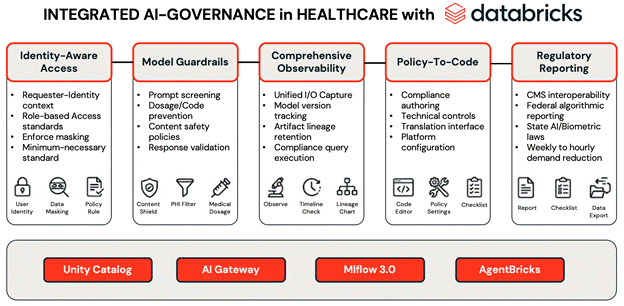
When you look past regulatory terminology and focus solely on practical operations, healthcare AI governance has to meet all four of the following requirements at the same time.
Identity-aware data access
Every query that touches PHI data must be aware of the identity of the requester, the role they hold within the organization, the applicable minimum necessary standard, and the de-identification or tokenization rules that should be enforced before the data leaves the system. This enforcement must occur automatically as a property of the platform, rather than depending on the discipline of individual developers.
Guardrails to the model layer
In the absence of appropriate controls, foundation models are capable of generating incorrect medication dosages, fabricating diagnostic codes, and confidently misrepresenting established clinical guidelines. Guardrails constitute the technical layer responsible for screening prompts before they reach the model and validating responses before they are presented to a clinician or downstream system.
Comprehensive observability
When the Office for Civil Rights, a state attorney general, or an internal audit team requests an account of what an AI agent did at a particular moment several months in the past, the organization must be in a position to respond within hours rather than weeks. This necessitates the capture and retention of inputs, outputs, model versions, data sources, tool invocations, and the lineage of every artefact produced, all in a form that supports structured query and review.
Policy into executable code
Compliance functions are responsible for authoring policy. Engineering functions are responsible for ensuring that those policies are reflected in technical controls. The point at which this translation occurs, or fails to occur, is where the majority of governance programmes encounter difficulty.
A platform that addresses only a subset of these four requirements produces the appearance of governance rather than its substance, and is unlikely to withstand sustained regulatory or operational scrutiny.
The Databricks Position
Databricks has invested substantially over the past several years in building these capabilities into the platform itself, rather than relying on systems integrators or third-party tools to provide them. For healthcare leaders evaluating their broader AI architecture, this integrated design represents the most meaningful point of differentiation. To explain these native capabilities, four components of the Databricks platform explained below warrant particular attention.
Unity Catalog
Unity Catalog functions as the access control plane within which PHI access rules are defined and enforced. It supports row-level filters, column masks, attribute-based access policies, dynamic views for de-identification, and end-to-end lineage across tables, notebooks, dashboards, models, and AI agents.
When a care management agent issues a query against patient data, Unity Catalog applies the same rules that govern access by human analysts. There is no parallel permissions model maintained for AI workloads, no shadow copy of data created for agent consumption, and no exception path that bypasses the central control plane. From a HIPAA perspective, this represents the difference between asserting that controls are in place and being able to demonstrate that they are.
AI Gateway
The Databricks AI Gateway is positioned between enterprise applications and the model layer, regardless of whether the model in question is served from within Databricks, accessed through a partner endpoint such as Anthropic Claude or Azure OpenAI, or operated as a fine-tuned model within the customer’s own workspace.
The Gateway enforces detection of personally identifiable and protected health information on inbound prompts, applies content safety policies to outbound responses, and provides centralized rate limiting, cost controls, and a unified audit log that spans every model the enterprise consumes. For a Chief Information Officer working to standardise AI consumption across multiple clinical and operational teams, the Gateway functions as the control point at which enterprise policy becomes enforceable in practice.
MLflow and Lakehouse Monitoring
Every model registration, every agent invocation, every input and output, and every tool call is captured with associated lineage and made available for subsequent review.
When a clinician raises a question about the reasoning behind a particular care recommendation, the platform supports reconstruction of that reasoning from the original artefacts. When a regulator requests evidence of monitoring activity for a sepsis prediction model, the monitoring framework has already been operating throughout the model’s production lifetime, and the relevant evidence is available on demand.
AgentBricks
The technical task of building an agent has become significantly easier. The more demanding task is the construction of an agent that respects PHI boundaries, escalates appropriately to a human operator when its confidence drops below a defined threshold, records every material decision, and operates strictly within the permissions defined in Unity Catalog. AgentBricks provides healthcare engineering teams with an opinionated framework in which these governance properties are inherited by default, rather than being applied as an additional layer following initial development.
Application in Healthcare
The most useful way to evaluate any governance framework is to consider how it operates against the workloads that healthcare organizations are actively deploying. Four applications merit particular attention, as they correspond directly to the areas in which most health systems and payers are presently investing.
Secure EHR Analytics
A Databricks Lakehouse can be connected to an EHR system, or a payer claims warehouse, and governed analytics can be made available to clinical leadership, population health teams, and finance functions through Unity Catalog enforced views. Sensitive fields are masked by default, while de-identified cohorts can be generated as needed to support research without moving data to other environments. Lineage information also enables precise tracking of source records for any downstream report or model.
Agentic Care Management
Care management staff are typically responsible for substantial patient panels, and agentic workflows offer meaningful scope to support them by prioritizing outreach, drafting personalized communications, surfacing gaps in care, and preparing visit summaries. Such agentic workflows introduce significant exposure under HIPAA when applied without appropriate guardrails. In a Databricks implementation, every agent action is bounded by Unity Catalog permissions, every output is subject to AI Gateway content controls, and every interaction is recorded in a form that supports compliance review. The clinical judgement remains with the care manager, while the administrative burden is absorbed by the agent.
Clinical AI Observability
A diagnostic support model that drifts gradually in production presents a more serious risk than one that fails visibly. Lakehouse Monitoring provides continuous tracking of model performance, data quality, and behavioral drift, and generates alerts when measured properties move outside defined tolerances. This capability is essential for models that influence clinical decision-making and it determines whether an AI ecosystem can be defended or not to a regulator or clinical board.
Regulatory Reporting
Organizations must be able to provide evidence on request to comply with CMS interoperability rules, federal algorithmic reporting requirements, and diverse state-level AI and biometric transparency laws. When governance is embedded within the platform, the production of that evidence becomes a matter of executing a query rather than commissioning a discrete project. Reports that have historically required several weeks of manual compilation can be implemented as reproducible workflows that run on demand.
From Principle to Control
The value of these capabilities becomes clearer when each is mapped to a specific HIPAA obligation and the corresponding implementation pattern in the Databricks platform. The four examples that follow are among those most frequently raised by Chief Compliance Officers and Chief Privacy Officers in steering committee reviews, and each is supported by a defined platform mechanism in Databricks.
Minimum Necessary Standard
The Principle - According to 45 CFR §164.502(b), every workforce member, application, or AI agent should only access elements of a patient record that are necessary for their specific task. A treating clinician requires the full record whereas a billing analyst does not.
The Databricks Implementation - A single underlying patient table is governed by two Unity Catalog policies. Column masks redact sensitive fields such as identifiers or notes based on the requesting user's group. Row filters restrict which patient records a user sees based on attributes such as clinical unit or geography, synchronized from the corporate identity provider. The same policies apply whether the consumer is a notebook, a dashboard, a BI tool, or an AI agent operating under a service principal.
The Outcome - The standard becomes a technical control evaluated on every query rather than a written policy enforced through training. The evidence of enforcement can be obtained by querying the Unity Catalog audit logs.
Audit Controls
The Principle - The Technical Safeguards at 45 CFR §164.312(b) require mechanisms to record and examine any activity in systems that contain or use Protected Health Information. This requirement is applied to any service principal acting on behalf of an AI agent, as well as human users.
The Databricks Implementation - The platform writes every access event to the system tables, including for principal level activity and for downstream propagation. A compliance dashboard built on these tables surfaces queries against flagged columns, activity by AI service principals, and access patterns that fall outside established baselines. The same data can be used for the periodic access reviews that are required by most internal audit programmes.
The Outcome - Audit evidence is produced as a continuous data product rather than as a discrete project commissioned in response to a specific request. Compliance teams operate the dashboard directly, without requiring engineering involvement for routine review.
PHI Detection on AI Inputs and Outputs
The Principle – Foundation models present a unique risk not typically associated with conventional applications, as there is potential for Protected Health Information to be inadvertently included in user prompts or produced within model responses. This exposure exists regardless of whether the model is hosted internally or accessed through an external provider.
The Databricks Implementation - The AI Gateway sits between calling applications and the model layer, and supports inbound and outbound guardrail policies. An inbound policy detects and blocks the eighteen Safe Harbor identifiers in prompts directed to model endpoints. An outbound policy applies the same detection to generated responses before they are returned to the caller. The policies apply uniformly across models served from within Databricks and those reached through partner endpoints such as Anthropic Claude or Azure OpenAI.
The Outcome - The risk of unintentional disclosure through an AI pathway is reduced to a controlled and logged exception, rather than relying on application developers to implement detection in each calling system.
Breach Notification Preparedness
The Principle - Under 45 CFR §164.404, the organization has sixty days from discovery of a breach to notify the individuals affected. The operational difficulty is rarely the notification itself, but rather the determining precisely which patients were potentially affected.
The Databricks Implementation - Unity Catalog maintains end-to-end lineage across tables, views, dashboards, models, and AI agents. Combined with the audit system tables, this lineage supports a query that reconstructs, for any given table and time window, the complete set of records accessed and the downstream artefacts in which those records appear. The query is parameterized and executed on demand by the compliance team.
The Outcome - The forensic work that historically required several days of coordination between engineering, compliance, and legal teams is reduced to a query executed within hours. The notification presents a clearer stance, and the supporting evidence remains consistent throughout the affected group.
These four examples are illustrative rather than exhaustive, and the same pattern of principle, platform implementation, and compliance outcome extends across the broader set of HIPAA Technical and Administrative Safeguards. The point worth emphasizing is that the controls are configured once at the platform level and apply uniformly to every workload, including those operated by autonomous agents.
Responsible AI - An Operational Model
Healthcare leaders best positioned to excel over the next two years will recognize responsible AI in healthcare as a critical operational framework. This model necessitates a data platform where access control, guardrails, observability, and auditing are integrated by default rather than added as custom features. Additionally, it is essential that engineering and compliance teams operate from a unified source of truth, and that implementation partners possess a comprehensive understanding of both HIPAA regulations and the unique operational requirements of agentic AI systems.
Databricks provides the platform on which this operating model can be constructed. The design of the operating model itself remains the responsibility of each organization. The encouraging development is that this design no longer requires a trade-off between speed of delivery and safety of operation. By leveraging Unity Catalog, AI Gateway, MLflow, and AgentBricks together, healthcare organizations can operate at a significantly accelerated pace compared to siloed legacy systems, while also maintaining a substantially strong audit position than before.
Next Steps
For organizations currently addressing these questions at the leadership level, a prudent approach generally starts with a comprehensive evaluation of the current AI governance framework. This is then followed by a focused remediation strategy to implement platform-level controls prior to expanding agentic workloads. Our Databricks practice has developed a defined approach to support healthcare and life sciences organizations through this exercise.
Governance Baseline Assessment
A focused engagement, typically conducted over four to six weeks, in which our team reviews your current AI governance framework against the four core requirements outlined in this article and delivers a prioritized set of recommendations specific to your Databricks environment. The assessment covers Unity Catalog configuration, AI Gateway readiness, observability coverage across MLflow and Lakehouse Monitoring, and the maturity of your agentic AI controls.
We would welcome the opportunity to begin that conversation. The autonomous enterprise within healthcare is no longer a prospective concept, and the central question facing the leadership teams is whether the supporting governance framework can advance at the same pace.