
Executive Summary
Prior authorization (PA) has become one of the most visible operational bottlenecks in U.S. healthcare—driving care delays, avoidable denials, clinician abrasion, and administrative cost. The near-term opportunity is not just "more automation," but a shift to agentic workflows: multiple specialized AI agents that retrieve evidence, interpret policy, reason clinically, and coordinate bi-directional exchange while maintaining auditability. This blueprint outlines how to move from rigid rules to adaptive intelligence.
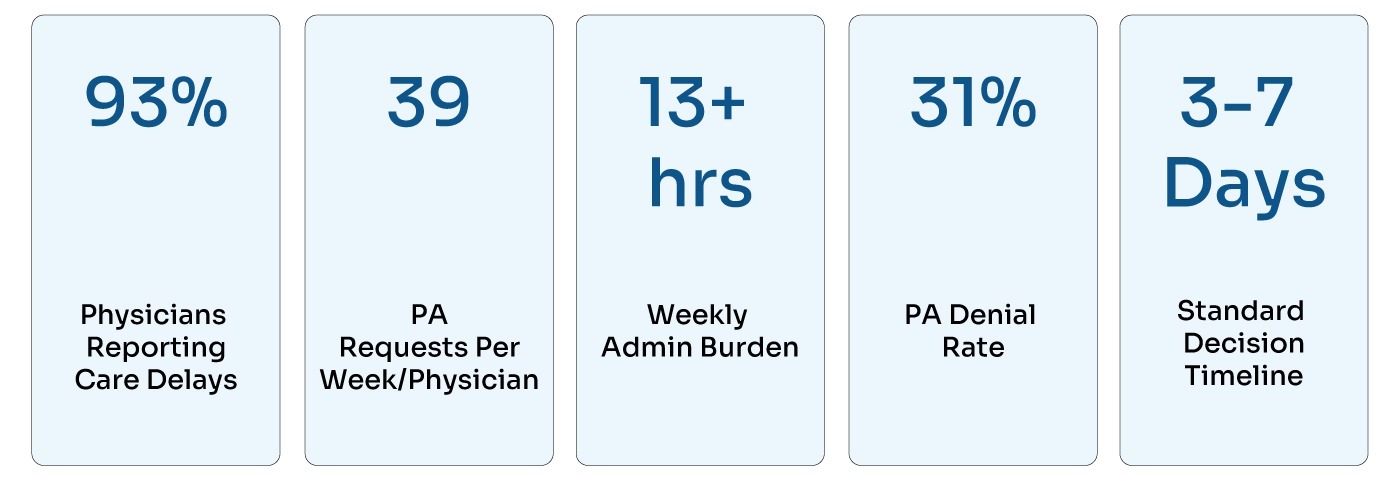
The Problem: A System at a Breaking Point
Current benchmarking reveals a fragmented, high-friction workflow that punishes every stakeholder. From the AMA's 2024 physician survey and Mastech Digital's industry analysis, the scale of operational friction is unsustainable. Physicians and staff are buried in "chart mining," while payers struggle with incomplete submissions that trigger manual pends.
Why "Traditional Automation" Hasn't Solved It
Many organizations have attempted to solve this with portals, forms, and RPA, yet the burden persists. The failure stems from inherent limitations in legacy approaches:
-
Rules-Based Brittleness: Rigid if/then logic breaks whenever policies change or edge cases arise, requiring constant maintenance.
-
Limited Clinical Reasoning: RPA cannot "understand" medical necessity or justify why a treatment aligns with complex guidelines.
-
Siloed Systems: Payer and provider workflows remain isolated with no real-time data sharing.
-
Fragmented Data: Critical clinical evidence is scattered across structured EHR fields, PDF notes, labs, and imaging systems.
-
Opaque Decisions: "Black box" denials provide no clear clinical rationale, leading to unnecessary appeals.
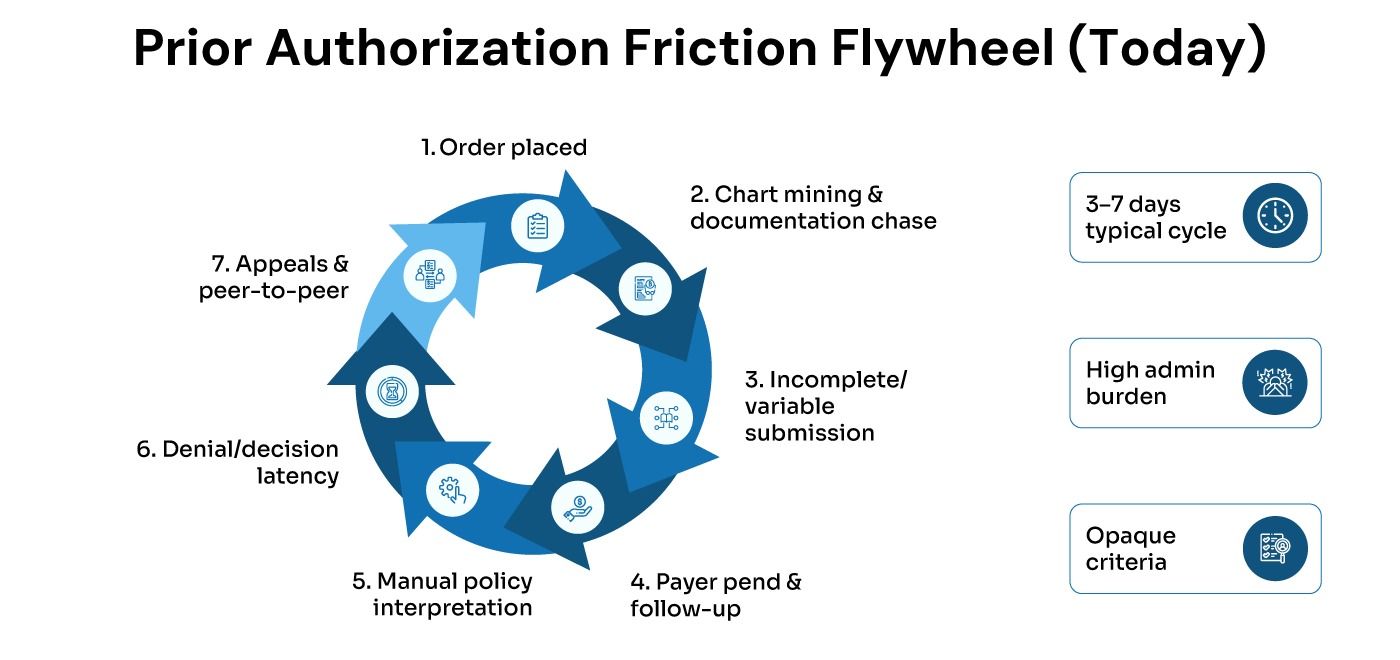
Figure 1 : Prior Authorization Friction Flywheel (Today) - The current loop of delays, denials, and rework
The Shift: From Linear Processing to Orchestrated Multi-Agents
What "Agentic Prior Auth" Means in Operational Terms
Agentic PA is not merely a chatbot or generative text tool. It is an orchestrated ecosystem of specialized agents that decompose the complex PA process into autonomous but coordinated tasks. Mastech Digital defines this architecture through eight core roles:
1. Intake Agent: Validates request completeness and triggers workflows
2. Context Synthesis Agent: Builds patient profile from EHR history/notes.
3. Evidence Collection Agent: Retrieves guideline, labs, and imaging data.
4. Policy Intelligence Agent: Interprets PDF/text policies into logic.
5. Reasoning Agent: Applies clinical logic to determine necessity.
6. Narrative Generation Agent: Drafts evidence-backed clinical letters.
7. Payer Comms Agent: Manages API /EDI submissions & status tracking.
8. Appeal/Optimization Agent: Learns from outcomes to improve yield.
The New Workflow: Minutes for Routine, Hours for Complex
This approach transforms a serial, manual process into parallelized, intelligent operations. Routine cases are processed in minutes with high auto-approval rates, while complex cases are prepared with full dossiers for human review.
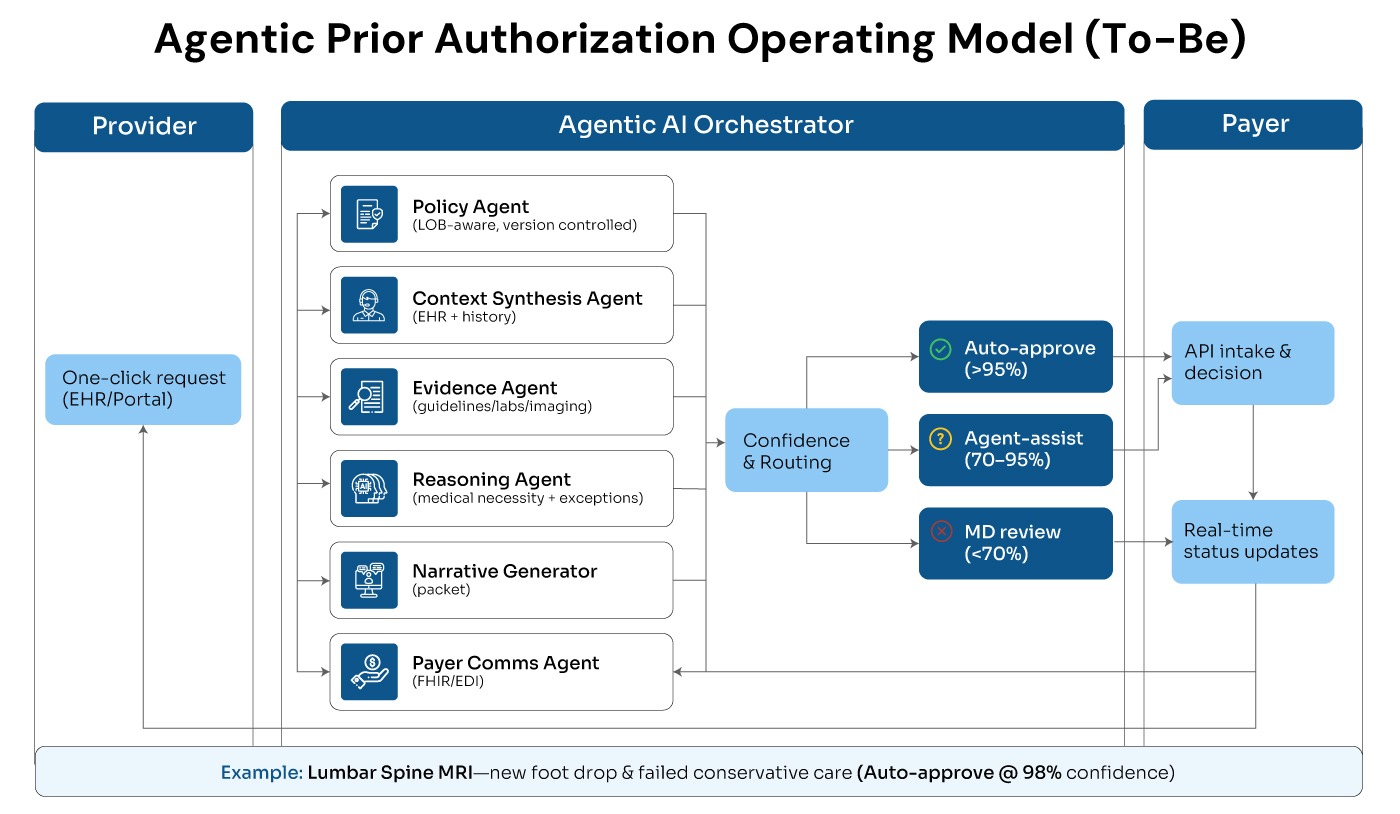 Figure 2: Agentic Prior Authorization Operating Model (To-Be) - Orchestrated intelligence with multi-agent collaboration
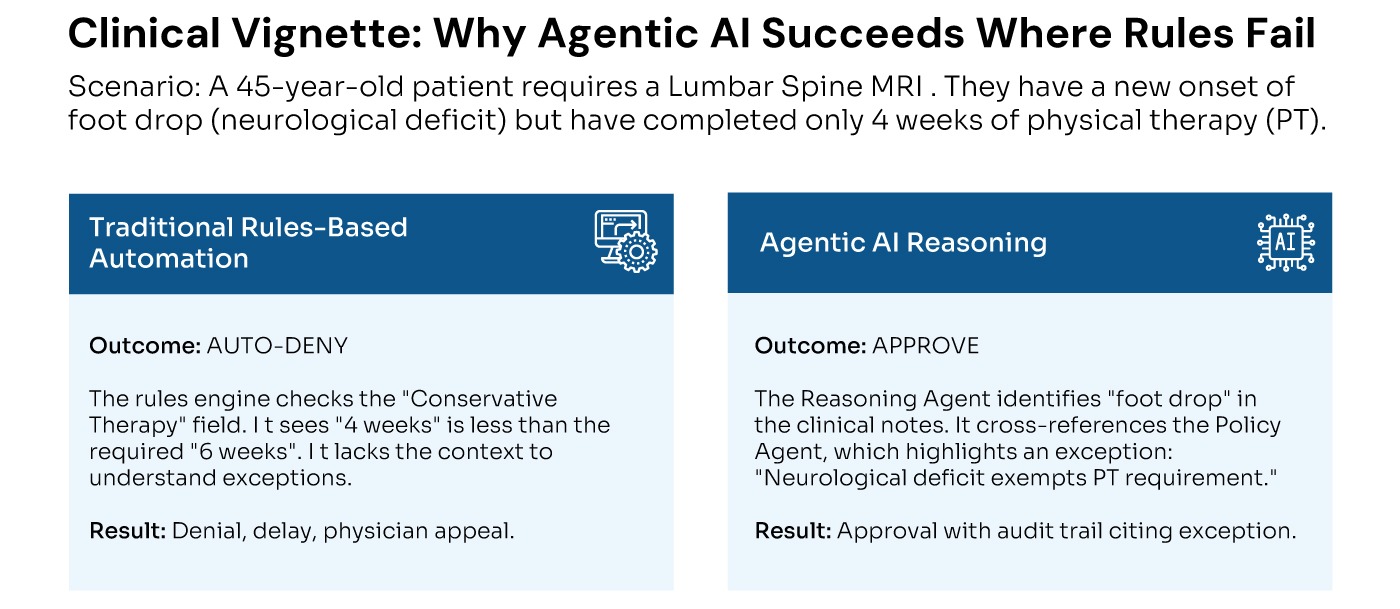
Why Now: The Interoperability Tailwind
The regulatory landscape is creating the necessary infrastructure for this shift. The CMS Interoperability and Prior Authorization Final Rule (CMS-0057-F) mandates impacted payers to implement FHIR-based APIs by 2027 and meet strict decision timeframes starting in 2026. Coupled with HL7 Da Vinci standards (CRD, DTR, PAS), the industry is moving toward a standardized data fabric that Agentic AI can leverage to automate decisioning securely and transparently.
The Blueprint: Architecture, Governance, and Path to Production
Reference Architecture: Build an "Agentic Fabric," Not a Monolith
Successful implementation requires a multi-layer ecosystem rather than a rigid software suite. The architecture consists of:
-
Experience Layer: EHR Embedded Apps (SMART on FHI R) and Provider/Payer Portals.
-
Intelligence Layer: The swarm of specialized agents (Reasoning, Evidence, Policy).
-
Data Layer: Unified access to EHRs, PACS, Labs, and Clinical Guidelines.
-
Governance Layer: The critical "human-in-the-loop" controls, audit logging, and compliance checks.
Operational KPIs That Matter
Success must be measured across all stakeholders to ensure the system is working holistically:
-
Provider KPI s: Reduction in time spent per request, increase in first-pass approval rates, and improvement in staff productivity.
-
Payer KPI s: Lower cost per authorization, higher auto-approval (touchless) rates, reduced appeal volumes, and higher clinical accuracy.
-
Patient KPI s: Faster time-to-treatment, improved continuity of care, and greater transparency on out-of-pocket costs.
Governance and Safety: The Non-Negotiables
Agentic AI in healthcare demands rigorous oversight. Key governance pillars include HI PAA/SOC2 compliance for data security, comprehensive audit trails for every agent decision, bias detection to ensure equitable outcomes, and mandatory human-in-the-loop workflows for denials or low-confidence predictions. AI should augment, not replace, clinical judgment in complex scenarios.
Preparing for the Future
As we approach 2026, the conversation is shifting from "digitizing forms" to "orchestrating
intelligence." By adopting an agentic operating model, healthcare organizations can break the friction flywheel—reducing administrative waste, empowering clinicians, and, most importantly, accelerating patient access to care.
References
-
AMA 2024 Prior Authorization Physician Survey. American Medical Association.
-
CMS Interoperability and Prior Authorization Final Rule (CMS-0057-F). Centers for Medicare & Medicaid Services.
-
HL7 Da Vinci Project: Prior Authorization Support (PAS) Implementation Guide.
-
2024 CAQH Index on Healthcare Administrative Compliance and Efficiency